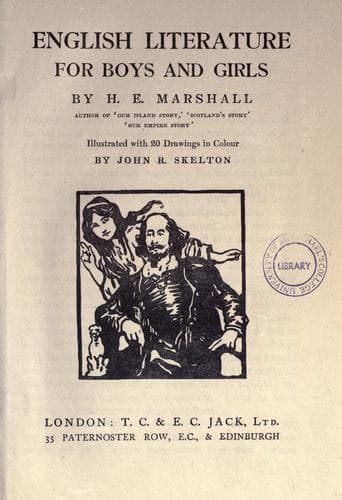
English Literature for Boys and GirlsMarshall, H. E. (Henrietta Elizabeth)
History
English Literature for Boys and Girls
Marshall, H. E. (Henrietta Elizabeth)
English literature -- History and criticism
"But the mother, yea, and that also in good earnest: 'Peace,
son,' saith she, 'I think he be some of the Ambassadors' fools.'
"Some found fault with their golden chains, as to no use nor
purpose; being so small and weak, that a bondman might easily
break them; and again so wide and large that, when it pleased
him, he might cast them off, and run away at liberty whither he
would.
"But when the Ambassadors had been there a day or two, and saw so
great abundance of gold so lightly esteemed, yea, in no less
reproach than it was with them in honour; and, besides that, more
gold in the chains and gyves of one fugitive bondman, than all
the costly ornaments of their three was worth; then began a-bate
their courage, and for very shame laid away all that gorgeous
array whereof they were so proud; and especially when they had
talked familiarly with the Utopians, and had learned all their
fashions and opinions. For they marvel that any man be so
foolish as to have delight and pleasure in the glistering of a
little trifling stone, which may behold any of the stars, or else
the sun itself; or that any man is so mad as to count himself the
nobler for the smaller or finer thread of wool, which self-same
wool (be it now in never so fine a spun thread) did once a sheep
wear, and yet was she all that time no other thing than a sheep."
Chapter XXXVIII THE DEATH OF SIR THOMAS MORE
THERE is much that is quaint, much that is deeply wise, in More's
Utopia, still no one is likely to agree with all he says, or to
think that we could all be happy in a world such as he describes.
For one thing, to those of us who love color it would seem a dull
world indeed were we all forced to dress in coarse-spun, undyed
sheep's wool, and if jewels and gold with all their lovely lights
and gleamings were but the signs of degradation. Each one who
reads it may find something in the Utopia that he would rather
have otherwise. But each one, too, will find something to make
him think.
More was not the first to write about a happy land where every
one lived in peace and where only justice reigned. And if he got
some of his ideas of the island from the discoveries of the New
World, he got many more from the New Learning. For long before,
Plato, a Greek writer, had told of a land very like Utopia in his
book called the Republic. And the New Learning had made that
book known to the people of England.
We think of the Utopia as English Literature, yet we must
remember that More wrote it in Latin, and it was not translated
into English until several years after his death. The first
English translation was made by Ralph Robinson, and although
since then there have been other translation which in some ways
are more correct, there has never been one with more charm. For
Robinson's quaint English keeps for us something of the spirit of
More's time and of More's self in a way no modern and more
perfect translation can.
Public-domain text, read in full here on John Shaqi.
Reviews
Reviews
No reviews yet
Be the first to share your thoughts on this work.
Elsewhere in the archive
Join the Discussion
Join the discussion
Sign in to leave a comment or review.
Sign InorCreate an account