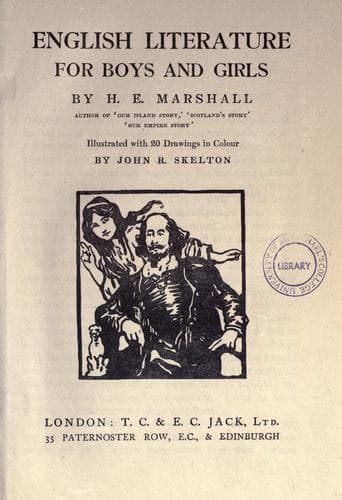
English Literature for Boys and GirlsMarshall, H. E. (Henrietta Elizabeth)
History
English Literature for Boys and Girls
Marshall, H. E. (Henrietta Elizabeth)
English literature -- History and criticism
The Utopia was not written for one time or for one people. Even
before it was translated into English it had been translated into
Dutch, Italian, German, and French and was largely read all over
the Continent. It is still read to-day by all who are interested
in the life of the people, by all who think that in "this best of
all possible worlds" things might still be made better.
More wrote many other books both in English and in Latin and
besides being a busy author he led a busy life. For blustering,
burly, selfish King Henry loved the gentle witty lawyer, and
again and again made use of his wits. "And so from time to time
was he by the King advanced, continuing in his singular favour
and trusty service twenty years and above."*
*W. Roper.
It was not only for his business cleverness that King Henry loved
Sir Thomas. It was for his merry, witty talk. When business was
done and supper-time came, the King and Queen would call for him
"to be merry with them." Thus it came about that Sir Thomas
could hardly ever get home to his wife and children, where he
most longed to be. Then he began to pretend to be less clever
than he was, so that the King might not want so much of his
company. But Henry would sometimes follow More to his home at
Chelsea, where he had built a beautiful house. Sometimes he came
quite unexpectedly to dinner. Once he came, "and after dinner,
in a fair garden of his, walked with him by the space of an hour,
holding his arm about his neck." As soon as the King was gone,
More's son-in-law said to him that he should be happy seeing the
King was so friendly with him, for with no other man was he so
familiar, not even with Wolsey.
"I thank our Lord," answered More, "I find in his Grace a very
good lord indeed, and I believe he doth as singularly favour me
as any subject within the realm. Howbeit, son Roper, I may tell
thee, I have no cause to be proud thereof, for if my head would
win him a castle in France it should not fail to go."
And Sir Thomas was not wrong. Meanwhile, however, the King
heaped favor upon him. He became Treasurer of the Exchequer,
Speaker of the House of Commons, Chancellor of the Duchy of
Lancaster, and last of all Lord Chancellor of England. This was
a very great honor. And as More was a layman the honor was for
him greater than usual. For he was the first layman to be made
Chancellor. Until then the Chancellor had always been some
powerful Churchman.
More was not eager for these honors. He would much rather have
lived a simple family life, but bluff King Hal was no easy master
to serve. If he chose to honor a man and set him high, that man
could but submit. So, as Erasmus says, More was dragged into
public life and honor, and being thus dragged in troubles were
not slow to follow.
Public-domain text, read in full here on John Shaqi.
Reviews
Reviews
No reviews yet
Be the first to share your thoughts on this work.
Elsewhere in the archive
Join the Discussion
Join the discussion
Sign in to leave a comment or review.
Sign InorCreate an account