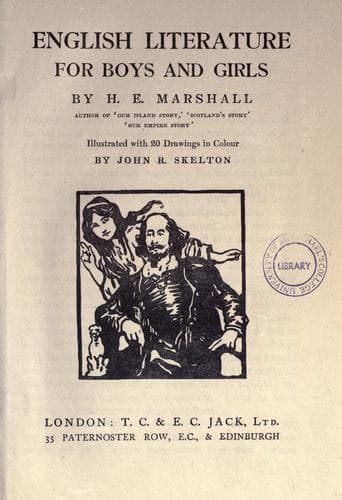
English Literature for Boys and GirlsMarshall, H. E. (Henrietta Elizabeth)
History
English Literature for Boys and Girls
Marshall, H. E. (Henrietta Elizabeth)
English literature -- History and criticism
The Sonnet is a poem of fourteen lines, and is perhaps the most
difficult kind of poem to write. It is divided into two parts.
The first part has eight lines and ought only to have two rimes.
That is, supposing we take words riming with love and king for
our rimes, four lines must rime with love and four with king.
The rimes, too, must come in a certain order. The first, fourth,
fifth and eighth lines must rime, and the second, third, sixth,
and seventh. This first part is called the octave, from the
Latin word octo, eight. The second part contains six lines, and
is therefore called the sextet, from the Latin word sex, meaning
six. The sextet may have either two or three rimes, and these
may be arranged in almost any order. But a correct sonnet ought
not to end with a couplet, that is two riming lines. However,
very many good writers in English do so end their sonnets.
As the sonnet is so bound about with rules, it often makes the
thought which it expresses sound a little unreal. And for that
very reason it suited the times in which Wyatt lived. In those
far-off days every knight had a lady whom he vowed to serve and
love. He took her side in every quarrel, and if he were a poet,
or even if he were not, he wrote verses in her honor, and sighed
and died for her. The lady was not supposed to do anything in
return; she might at most smile upon her knight or drop her
glove, that he might be made happy by picking it up. In fact,
the more disdainful the lady might be the better it was, for then
the poet could write the more passionate verses. For all this
love and service was make-believe. It was merely a fashion and
not meant to be taken seriously. A man might have a wife whom he
loved dearly, and yet write poems in honor of another lady
without thought of wrong. The sonnet, having something very
artificial in it, just suited this make-believe love.
Petrarch, the great Italian poet, from whom you remember Chaucer
had learned much, and whom perhaps he had once met, made use of
this kind of poem. In his sonnets he told his love of a fair
lady, Laura, and made her famous for all time.
Of course, when Wyatt came to Italy Petrarch had long been dead.
But his poems were as living as in the days of Chaucer, and it
was from Petrarch's works that Wyatt learned this new kind of
poem, and it was he who first made use of it in English. He,
too, like Petrarch, addressed his sonnets to a lady, and the lady
he took for his love was Queen Anne Boleyn. As he is the first,
he is perhaps one of the roughest of our sonnet writers, but into
his sonnets he wrought something of manly strength. He does not
sigh so much as other poets of the age. He says, in fact, "If I
serve my lady faithfully I deserve reward." Here is one of his
sonnets, which he calls "The lover compareth his state to a ship
in perilous storm tossed by the sea."
Public-domain text, read in full here on John Shaqi.
Reviews
Reviews
No reviews yet
Be the first to share your thoughts on this work.
Elsewhere in the archive
Join the Discussion
Join the discussion
Sign in to leave a comment or review.
Sign InorCreate an account