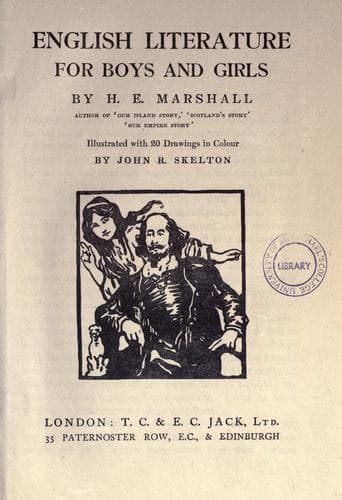
English Literature for Boys and GirlsMarshall, H. E. (Henrietta Elizabeth)
History
English Literature for Boys and Girls
Marshall, H. E. (Henrietta Elizabeth)
English literature -- History and criticism
Miles Coverdale followed him with a complete translation in
happier times. For Henry VIII, for his own purposes, wished to
spread a knowledge of the Bible, and commanded that a copy of
Coverdale's Bible should be placed in every parish church. And
although Coverdale was not so great a scholar as Tyndale, his
language was fine and stately, with a musical ring about the
words, and to this day we still keep his version of the Psalms in
the Prayer Book.
Other versions of the Bible followed these, until in 1611, in the
reign of James I and VI, the translation which we use to-day was
at length published. That has stood and still stands the test of
time. And, had we no other reason to treasure it, we would still
for its simple musical language look upon it as one of the fine
things in our literature.
BOOKS TO READ
Life of Sir Thomas More (King's Classics, modern English), by W.
Roper (his son-in-law). Utopia (King's Classics, modern
English), translated by R. Robinson. Utopia (old English),
edited by Churton Collins.
Chapter XXXIX HOW THE SONNET CAME TO ENGLAND
UPON a January day in 1527 two gaily decked barges met upon the
Thames. In the one sat a man of forty. His fair hair and beard
were already touched with gray. His face was grave and
thoughtful, and his eyes gave to it a curious expression, for the
right was dull and sightless, while with the left he looked about
him sharply. This was Sir John Russell, gentleman of the Privy
Chamber, soldier, ambassador, and favorite of King Henry VIII.
Fighting in the King's French wars he had lost the sight of his
right eye. Since then he had led a busy life in court and camp,
passing through many perilous adventures in the service of his
master, and now once again by the King's commands he was about to
set forth for Italy.
As the other barge drew near Russell saw that in it there sat
Thomas Wyatt, a young poet and courtier of twenty-three. He was
tall and handsome, and his thick dark hair framed a pale, clever
face which now looked listless. But as his dreamy poet's eyes
met those of Sir John they lighted up. The two men greeted each
other familiarly. "Whither away," cried Wyatt, for he saw that
Russell was prepared for a journey.
"To Italy, sent by the King."
To Italy, the land of Poetry! The idea fired the poet's soul.
"And I," at once he answered, "will, if you please, ask leave,
get money, and go with you."
"No man more welcome," answered the ambassador, and so it was
settled between them. The money and the leave were both
forthcoming, and Thomas Wyatt passed to Italy. This chance
meeting and this visit to Italy are of importance to our
literature, because they led to a new kind of poem being written
in English. This was the Sonnet.
Public-domain text, read in full here on John Shaqi.
Reviews
Reviews
No reviews yet
Be the first to share your thoughts on this work.
Elsewhere in the archive
Join the Discussion
Join the discussion
Sign in to leave a comment or review.
Sign InorCreate an account