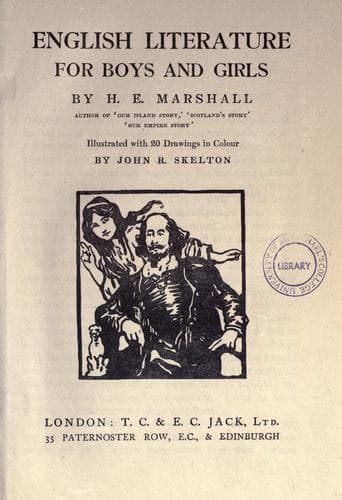
English Literature for Boys and GirlsMarshall, H. E. (Henrietta Elizabeth)
History
English Literature for Boys and Girls
Marshall, H. E. (Henrietta Elizabeth)
English literature -- History and criticism
*Delicacies.
. . . . . . .
So forth she goes, trusting of all this wealth
With her sister her part so for to shape,
That if she might there keep herself in health,
To live a Lady, while her life do last.
And to the door now is she come by stealth,
And with her foot anon she scrapes full fast.
Th' other for fear durst not well scarce appear,
Of every noise so was the wretch aghast.
At last she askéd softly who was there;
And in her language as well as she could,
'Peep,' quoth the other, 'sister, I am here.'
'Peace,' quoth the town mouse, 'why speaketh thou so loud?'
But by the hand she took her fair and well.
'Welcome,' quoth she, 'my sister by the Rood.'
She feasted her that joy it was to tell
The fare they had, they drank the wine so clear;
And as to purpose now and then it fell,
So cheered her with, 'How, sister, what cheer.'
Amid this joy befell a sorry chance,
That welladay, the stranger bought full dear
The fare she had. For as she looked ascance,
Under a stool she spied two flaming eyes,
In a round head, with sharp ears. In France
Was never mouse so feared, for the unwise
Had not ere seen such beast before.
Yet had nature taught her after her guise
To know her foe, and dread him evermore.
The town mouse fled, she knew whither to go;
The other had no shift, but wonders sore,
Fear'd of her life! At home she wished her tho';
And to the door, alas! as she did skip
(The heaven it would, lo, and eke her chance was so)
At the threshold her sill foot did trip;
And ere she might recover it again,
The traitor Cat had caught her by the hip
And made her there against her will remain,
That had forgot her poor surety and rest,
For seeming wealth, wherein she thought to reign."
That is not the end of the poem. Wyatt points the moral.
"Alas," he says, "how men do seek the best and find the worst."
"Although thy head were hooped with gold," thou canst not rid
thyself of care. Content thyself, then, with what is allotted
thee and use it well.
This satire Wyatt wrote while living quietly in the country,
having barely escaped with his life from the King's wrath. But
although he escaped the scaffold, he died soon after in his
King's service. Riding on the King's business in the autumn of
1542 he became overheated, fell into a fever, and died. He was
buried at Sherborne. No stone marks his resting-place, but his
friend and fellow-poet, Henry Howard, Earl of Surrey, wrote a
noble elegy:--
"A hea, where Wisdom mysteries did frame;
Whose hammers beat still, in that lively brain,
As on a stithy* where that some work of fame
Was daily wrought, to turn to Britain's gain.
Public-domain text, read in full here on John Shaqi.
Reviews
Reviews
No reviews yet
Be the first to share your thoughts on this work.
Elsewhere in the archive
Join the Discussion
Join the discussion
Sign in to leave a comment or review.
Sign InorCreate an account