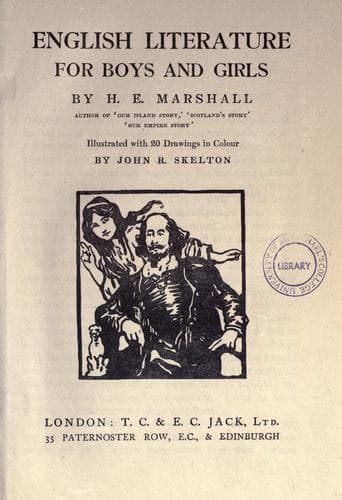
English Literature for Boys and GirlsMarshall, H. E. (Henrietta Elizabeth)
History
English Literature for Boys and Girls
Marshall, H. E. (Henrietta Elizabeth)
English literature -- History and criticism
*Anvil.
. . . . . . .
A hand, that taught what might be said in rhyme,
That Chaucer reft the glory of his wit.
A mark, the which (unperfected for time)
Some may approach; but never none shall hit!"
BOOKS TO READ
Early Sixteenth-Century Lyrics (Belle Lettres Series), edited by
F. M. Padelford (original spelling).
Chapter XL THE BEGINNING OF BLANK VERSE
THE poet with whose verses the last chapter ended was named Henry
Howard, Earl of Surrey. The son of a noble and ancient house,
Surrey lived a gay life in court and camp. Proud, hot-headed,
quick-tempered, he was often in trouble, more than once in
prison. In youth he was called "the most foolish proud boy in
England," and at the age of thirty, still young and gay and full
of life, he died upon the scaffold. Accused of treason, yet
innocent, he fell a victim to "the wrath of princes," the wrath
of that hot-headed King Henry VIII. Surrey lived at the same
time as Wyatt and, although he was fourteen years younger, was
his friend. Together they are the forerunners of our modern
poetry. They are nearly always spoken of together--Wyatt and
Surrey--Surrey and Wyatt. Like Wyatt, Surrey followed the
Italian poets. Like Wyatt he wrote sonnets; but whereas Wyatt's
are rough, Surrey's are smooth and musical, although he does not
keep the rules about rime endings. One who wrote not long after
the time of Wyatt and Surrey says of them, "Sir Thomas Wyatt, the
elder, and Henry, Earl of Surrey, were the two chieftains, who,
having travelled in Italy, and there tasted the sweet and stately
measures and style of the Italian poesie . . . greatly polished
our rude and homely manner of vulgar poesie from that it had been
before, and for that cause may justly be said the first reformers
of our English metre and syle. . . . I repute them for the two
chief lanterns of light to all others that have since employed
their pens on English poesie."*
*G. Puttenham, Art of English Poesie.
A later writer* has called Surrey the "first refiner" of our
language. And just as there comes a time in our own lives when we
begin to care not only for the story, but for the words in which
a story is told and for the way in which those words are used,
so, too, there comes such a time in the life of a nation, and
this time for England we may perhaps date from Wyatt and Surrey.
Before then there were men who tried to use the best words in the
best way, but they did it unknowingly, as birds might sing. The
language, too, in which they wrote was still a growing thing.
When Surrey wrote it had nearly reached its finished state, and
he helped to finish and polish it.
*W. J. Courthope.
Public-domain text, read in full here on John Shaqi.
Reviews
Reviews
No reviews yet
Be the first to share your thoughts on this work.
Elsewhere in the archive
Join the Discussion
Join the discussion
Sign in to leave a comment or review.
Sign InorCreate an account