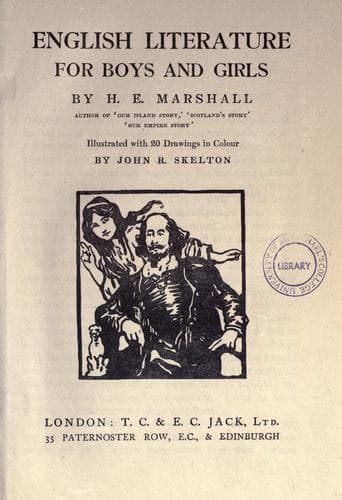
English Literature for Boys and GirlsMarshall, H. E. (Henrietta Elizabeth)
History
English Literature for Boys and Girls
Marshall, H. E. (Henrietta Elizabeth)
English literature -- History and criticism
As the fashion was, Surrey chose a lady to whom to address his
verses. She was the little Lady Elizabeth Fitz-Gerald, whose
father had died a broken-hearted prisoner in the Tower. She was
only ten when Surrey made her famous in song, under the name of
Geraldine. Here is a sonnet in which he, seeing the joy of all
nature at the coming of Spring, mourns that his lady is still
unkind:
"The sweet season, that bud and bloom forth brings,
With green hath clad the hill, and eke the vale,
The nightingale with feathers new she sings:
The turtle to her mate hath told her tale.
Summer is come, for every spray now springs,
The hart hath hung his old head on the pale,
The buck in haste his winter coat he flings;
The fishes float with new repaired scale,
The adder all her slough away she lings;
The swift swallow pursueth the flies small;
The busy-bee her honey now she mings;*
Winter is worn that was the flowers' bale.
And thus I see among these pleasant things
Each care decays, and yet my sorrow springs."
*Mingles.
Besides following Wyatt in making the sonnet known to English
readers, Surrey was the first to write in blank verse, that is in
long ten-syllabled lines which do not rime. This is a kind of
poetry in which some of the grandest poems in our language are
written, and we should remember Surrey as the first maker of it.
For with very little change the rules which Surrey laid down have
been followed by our best poets ever since, so from the sixteenth
century till now there has been far less change in our poetry
than in the five centuries before. You can see this for yourself
if you compare Surrey's poetry with Layamon's or Langland's, and
then with some of the blank verse near the end of this book.
It was in translating part of Virgil's Aeneid that Surrey used
blank verse. Virgil was an ancient Roman poet, born 70 B. C.,
who in his book called the Aeneid told of the wanderings and
adventures of Aeneas, and part of this poem Surrey translated into
English.
This is how he tells of the way in which Aeneas saved his old
father by carrying him on his shoulders out of the burning town
of Troy when "The crackling flame was heard throughout the walls,
and more and more the burning heat drew near."
Public-domain text, read in full here on John Shaqi.
Reviews
Reviews
No reviews yet
Be the first to share your thoughts on this work.
Elsewhere in the archive
Join the Discussion
Join the discussion
Sign in to leave a comment or review.
Sign InorCreate an account