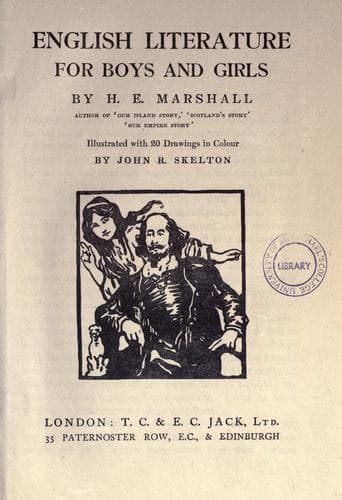
English Literature for Boys and GirlsMarshall, H. E. (Henrietta Elizabeth)
History
English Literature for Boys and Girls
Marshall, H. E. (Henrietta Elizabeth)
English literature -- History and criticism
We call the whole group of authors who sprang up at this time the
Elizabethans, after the name of the Queen in whose reign they
lived and wrote. And to those of us who know even a very little
of the time, the word calls up a brilliant vision. Great names
come crowding to our minds, names of poets, dramatists,
historians, philosophers, divines. It would be impossible to
tell of all in this book, so we must choose the greatest from the
noble array. And foremost among them comes Edmund Spenser, for
"the glory of the new literature broke in England with Edmund
Spenser."*
*J. R. Green, History of English People.
If we could stand aside, as it were, and take a wide view of all
our early literature, it would seem as if the names of Chaucer
and Spenser stood out above all others like great mountains. The
others are valleys between. They are pleasant fields in which to
wander, in which to gather flowers, not landmarks for all the
world like Chaucer and Spenser. And although it is easier and
safer for children to wander in the meadows and gather meadow
flowers, they still may look up to the mountains and hope to
climb them some day.
Edmund Spenser was born in London in 1552, and was the son of a
poor clothworker or tailor. He went to school at the Merchant
Taylors' School, which had then been newly founded. That his
father was very poor we know, for Edmund Spenser's name appears
among "certain poor scholars of the schools about London" who
received money and clothes from a fund left by a rich man to help
poor children at school.
When he was about seventeen Edmund went to Cambridge, receiving
for his journey a sum of ten shillings from the fund from which
he had already received help at school. He entered college as a
sizar, that is, in return for doing the work of a servant he
received free board and lodging in his college. A sizar's life
was not always a happy one, for many of the other scholars or
gentlemen commoners looked down upon them because of their
poverty. And this poverty they could not hide, for the sizars
were obliged to wear a different cap and gown from that of the
gentlemen commoners.
But of how Spenser fared at college we know nothing, except that
he was often ill and that he made two lifelong friends. That he
loved his university, however, we learn from his poems, when he
tenderly speaks of "my mother Cambridge."* When he left college
Spenser was twenty-three. He was poor and, it would seem, ill,
so he did not return to London, but went to live with relatives
in the country in Lancashire. And there about "the wasteful
woods and forest wide"** he wandered, gathering new life and
strength, taking all a poet's joy in the beauty and the freedom
of a country life, "for ylike to me was liberty and life,"** he
says. And here among the pleasant woods he met a fair lady named
Rosalind, "the widow's daughter of the glen."***
*Faery Queen, book IV canto xi.
**Shepherd's Calendar, December
***The same, April.
Public-domain text, read in full here on John Shaqi.
Reviews
Reviews
No reviews yet
Be the first to share your thoughts on this work.
Elsewhere in the archive
Join the Discussion
Join the discussion
Sign in to leave a comment or review.
Sign InorCreate an account