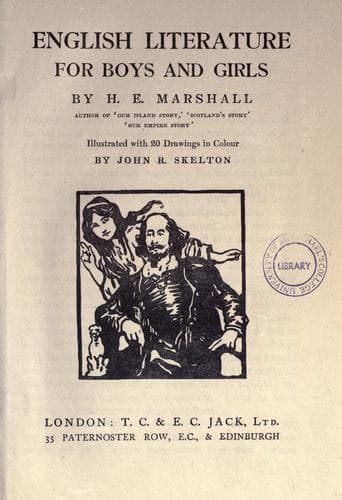
English Literature for Boys and GirlsMarshall, H. E. (Henrietta Elizabeth)
History
English Literature for Boys and Girls
Marshall, H. E. (Henrietta Elizabeth)
English literature -- History and criticism
Who Rosalind really was no one knows. She would never have been
heard of had not Spenser taken her for his lady and made songs to
her. Spenser's love for Rosalind was, however, more real than
the fashionable poet's passion. He truly loved Rosalind, but she
did not love him, and she soon married some one else. Then all
his joy in the summer and the sunshine was made dark.
"Thus is my summer worn away and wasted,
Thus is my harvest hastened all too rathe;*
The ear that budded fair is burnt and blasted,
And all my hopéd gain it turned to scathe:
Of all the seed, that in my youth was sown,
Was naught but brakes and brambles to be mown."**
*Early.
**Shepherd's Calendar, December.
At twenty-four life seemed ended, for "Love is a cureless
sorrow."*
*Shepherd's Calendar, August.
"Winter is come, that blows the baleful breath,
And after Winter cometh timely death."*
*Shepherd's Calendar, December.
And now, when he was feeling miserable, lonely, desolate an old
college friend wrote to him begging him to come to London.
Spenser went, and through his friend he came to know Sir Philip
Sidney, a true gentleman and a poet like himself, who in turn
made him known to the great Earl of Leicester, Elizabeth's
favorite.
Spenser thought his heart had been broken and that his life was
done. But hearts do not break easily. Life is not done at
twenty-four. After a time Spenser found that there was still
much to live for. The great Earl became the poet's friend and
patron, and gave him a post as secretary in his house. For in
those days no man could live by writing alone. Poetry was still
a graceful toy for the rich. If a poor man wished to toy with
it, he must either starve or find a rich friend to be his patron,
to give him work to do that would leave him time to write also.
Such a friend Spenser found in Leicester. In the Earl's house
the poor tailor's son met many of the greatest men of the court
of Queen Elizabeth. On the Earl's business he went to Ireland
and to the Continent, seeing new sights, meeting the men and
women of the great world, so that a new and brilliant life seemed
opening for him.
Yet when, a few years later, Spenser published his first great
poem, it did not tell of courts or courtiers, but of simple
country sights and sounds. This book is called the Shepherd's
Calendar, as it contains twelve poems, one for every month of the
year.
In it Spenser sings of his fair lost lady Rosalind, and he
himself appears under the name of Colin Clout. The name is
taken, as you will remember, from John Skelton's poem.
Spenser called his poems Aeclogues, from a Greek word meaning
Goatherds' Tales, "Though indeed few goatherds have to do
herein." He dedicated them to Sir Philip Sidney as "the
president of noblesse and of chivalrie."
Public-domain text, read in full here on John Shaqi.
Reviews
Reviews
No reviews yet
Be the first to share your thoughts on this work.
Elsewhere in the archive
Join the Discussion
Join the discussion
Sign in to leave a comment or review.
Sign InorCreate an account