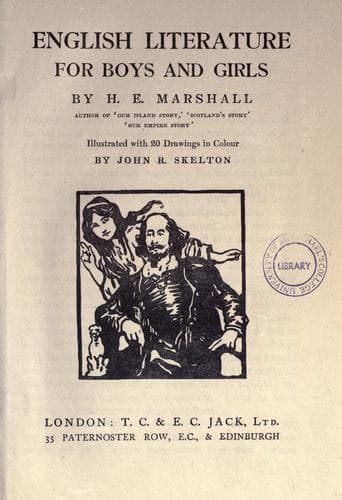
English Literature for Boys and GirlsMarshall, H. E. (Henrietta Elizabeth)
History
English Literature for Boys and Girls
Marshall, H. E. (Henrietta Elizabeth)
English literature -- History and criticism
"Go, little book: Thy self present,
As child whose parent is unkent,
To him that is the president
Of Noblesse and of Chivalrie;
And if that Envy bark at thee,
As sure it will, for succour flee
Under the shadow of his wing;
And, asked who thee forth did bring;
A shepherd's swain, say, did thee sing,
All as his straying flock he fed;
And when his honour hath thee read
Crave pardon for my hardyhood.
But, if that any ask thy name,
Say, 'thou wert basebegot with blame.'
For thy thereof thou takest shame,
And, when thou art past jeopardy,
Come tell me what was said of mee,
And I will send more after thee."
The Shepherd's Calendar made the new poet famous. Spenser was
advanced at court, and soon after went to Ireland in the train of
the Lord-Deputy as Secretary of State. At that time Ireland was
filled with storm and anger, with revolt against English rule,
with strife among the Irish nobles themselves. Spain also was
eagerly looking to Ireland as a point from which to strike at
England. War, misery, poverty were abroad in all the land. Yet
amid the horrid sights and sounds of battle Spenser found time to
write.
After eight years spent in the north of Ireland, Spenser was
given a post which took him south. His new home was the old
castle of Kilcolman in Cork. It was surrounded by fair wooded
country, but to Spenser it seemed a desert. He had gone to
Ireland as to exile, hoping that it was merely a stepping-stone
to some great appointment in England, whither he longed to
return. Now after eight years he found himself still in exile.
He had no love for Ireland, and felt himself lonely and forsaken
there. But soon there came another great Elizabethan to share
his loneliness. This was Sir Walter Raleigh, who, being out of
favor with his Queen, took refuge in his Irish estates until her
anger should pass.
The two great men, thus alone among the wild Irish, made friends,
and they had many a talk together. There within the gray stone
walls of the old ivy-covered castle Spenser read the first part
of his book, the Faery Queen, to Raleigh. Spenser had long been
at work upon this great poem. It was divided into parts, and
each part was called a book. Three books were now finished, and
Raleigh, loud in his praises of them, persuaded the poet to bring
them over to England to have them published.
In a poem called Colin Clout's come home again, which Spenser
wrote a few years later, he tells in his own poetic way of these
meetings and talks, and of how Raleigh persuaded him to go to
England, there to publish his poem. In Colin Clout Spenser calls
both himself and Raleigh shepherds. For just as at one time it
was the fashion to write poems in the form of a dream, so in
Spenser's day it was the fashion to write poems called pastorals,
in which the authors made believe that all their characters were
shepherds and shepherdesses.
Public-domain text, read in full here on John Shaqi.
Reviews
Reviews
No reviews yet
Be the first to share your thoughts on this work.
Elsewhere in the archive
Join the Discussion
Join the discussion
Sign in to leave a comment or review.
Sign InorCreate an account