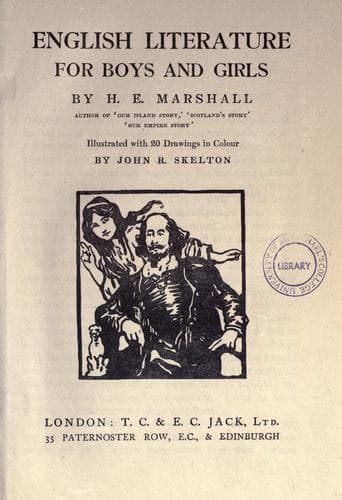
English Literature for Boys and GirlsMarshall, H. E. (Henrietta Elizabeth)
History
English Literature for Boys and Girls
Marshall, H. E. (Henrietta Elizabeth)
English literature -- History and criticism
"Where living creature none he did espy.
Then gan he loudly through the house to call;
But no man cared to answer to his cry;
There reigned a solemn silence over all,
Nor voice was heard, nor wight was seen in bower or hall.
At last, with creeping crooked pace forth came
An old, old man with beard as white as snow;
That on a staff his feeble steps did frame,
And guide his weary gate both to and fro,
For his eyesight him failéd long ago;
And on his arm a bunch of keys he bore,
The which unuséd rust did overgrow;
Those were the keys of every inner door,
But he could not them use, but kept them still in store."
And what was strange and terrible about this old man was that his
head was twisted upon his shoulders, so that although he walked
towards the knight his face looked backward.
Seeing his gray hairs and venerable look Prince Arthur asked him
gently where all the folk of the castle were.
"I cannot tell," answered the old man. And to every question he
replied, "I cannot tell," until the knight, impatient of delay,
seized the keys from his arm. Door after door the Prince Arthur
opened, seeing many strange, sad sights. But nowhere could he
find the captive Knight.
"At last he came unto an iron door,
That fast was locked, but key found not at all,
Amongst that bunch to open it withal."
But there was a little grating in the door through which Prince
Arthur called. A hollow, dreary, murmuring voice replied. It
was the voice of the Red Cross Knight, which, when the champion
heard, "with furious force and indignation fell" he rent that
iron door and entered in.
Once more the Red Cross Knight was free and reunited to his Lady,
while the false Duessa was unmasked and shown to be a bad old
witch, who fled away "to the wasteful wilderness apace."
But the Red Cross Knight was still so weak and feeble that
Despair almost persuaded him to kill himself. Seeing this, Una
led him to the house of Holiness, where he stayed until once more
he was strong and well. Here he learned that he was St. George.
"Thou," he is told,
"Shalt be a saint, and thine own nation's friend
And patron. Thou St. George shalt calléd be,
St. George of merry England, the sign of victory."
Once more strong of arm, full of new courage, the Knight set
forth with Una, and soon they reached her home, where the
dreadful Dragon raged.
Here the most fierce fight of all takes place. Three days it is
renewed, and on the third day the Dragon is conquered.
"So down he fell, and forth his life did breathe
That vanished into smoke and clouds swift;
So down he fell, that th' earth him underneath
Did groan, as feeble so great load to lift;
So down he fell, as an huge rocky clift
Whose false foundation waves have washed away,
With dreadful poise is from the mainland rift
And rolling down, great Neptune doth dismay,
So down he fell, and like an heapéd mountain lay."
Public-domain text, read in full here on John Shaqi.
Reviews
Reviews
No reviews yet
Be the first to share your thoughts on this work.
Elsewhere in the archive
Join the Discussion
Join the discussion
Sign in to leave a comment or review.
Sign InorCreate an account