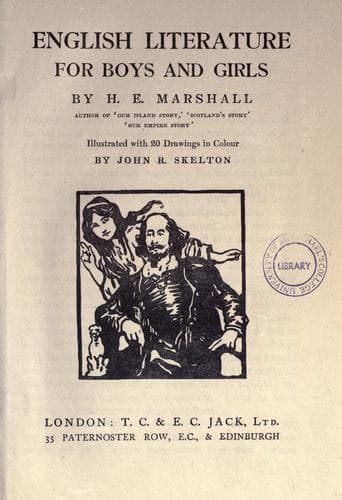
English Literature for Boys and GirlsMarshall, H. E. (Henrietta Elizabeth)
History
English Literature for Boys and Girls
Marshall, H. E. (Henrietta Elizabeth)
English literature -- History and criticism
Thus all ends happily. The aged King and Queen are rescued from
the brazen tower in which the Dragon had imprisoned them, and Una
and the Knight are married.
That is the story of the first book of the Faery Queen. In it
Spenser has made great use of the legend of St. George and the
Dragon. The Red Cross of his Knight, "the dear remembrance of
his dying Lord," was in those days the flag of England, and is
still the Red Cross of our Union Jack. And besides the allegory
the poem has something of history in it. The great people of
Spenser's day play their parts there. Thus Duessa, sad to say,
is meant to be the fair, unhappy Queen of Scots, the wicked
magician is the Pope, and so on. But we need scarcely trouble
about all that. I repeat that meantime it is enough for you to
enjoy the story and the poetry.
Chapter XLIII SPENSER--HIS LAST DAYS
THERE are so many books now published which tell the stories of
the Faery Queen, and tell them well, that you may think I hardly
need have told one here. But few of these books give the poet's
own words, and I have told the story here giving quotations from
the poem in the hope that you will read them and learn from them
to love Spenser's own words. I hope that long after you have
forgotten my words you will remember Spenser's, that they will
remain in your mind as glowing word-pictures, and make you
anxious to read more of the poem from which they are taken.
Spenser has been called the poet's poet,* he might also be called
the painter's poet, for on every page almost we find a word-
picture, rich in color, rich in detail. Each person as he comes
upon the scene is described for us so that we may see him with
our mind's eye. The whole poem blazes with color, it glows and
gleams with the glamor of fairyland. Spenser more than any other
poet has the old Celtic love of beauty, yet so far as we know
there was in him no drop of Celtic blood. He loved neither the
Irishman nor Ireland. To him his life there was an exile, yet
perhaps even in spite of himself he breathed in the land of
fairies and of "little people" something of their magic: his
fingers, unwittingly perhaps, touched the golden and ivory gate
so that he entered in and saw.
*Charles Lamb.
Public-domain text, read in full here on John Shaqi.
Reviews
Reviews
No reviews yet
Be the first to share your thoughts on this work.
Elsewhere in the archive
Join the Discussion
Join the discussion
Sign in to leave a comment or review.
Sign InorCreate an account