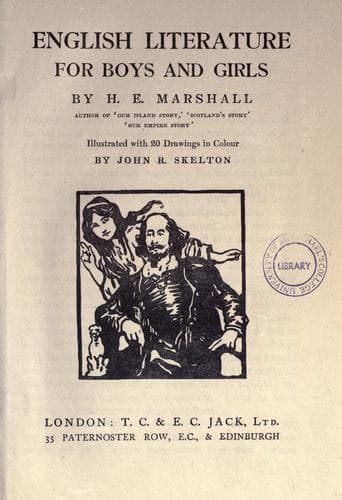
English Literature for Boys and GirlsMarshall, H. E. (Henrietta Elizabeth)
History
English Literature for Boys and Girls
Marshall, H. E. (Henrietta Elizabeth)
English literature -- History and criticism
So year after year went on. By slow degrees times changed, and
our literature changed with the times. But looking backward we
can see that the poet is the development of the minstrel, the
prose writer the development of the monkish chronicler and
copyist. Prose at first was only used for grave matters, for
history, for religious works, for dry treatises which were hardly
literature, which were not meant for enjoyment but only for use
and for teaching. But by degrees people began to use prose for
story-telling, for enjoyment. More and more prose began to be
written for amusement until at last it has quite taken the place
of poetry. Nowadays many people are not at all fond of poetry.
They are rather apt to think that a poetry book is but dull
reading, and they much prefer plain prose. It may amuse those
who feel like that to remember that hundreds of years ago it was
just the other way round. Then it was prose that was considered
dull--hence we have the word prosy.
All poetry was at first written to be sung, sung too perhaps with
some gesture, so that the hearers might the better understand the
story. Then by degrees poets got further and further away from
that, until poets like Spenser wrote with no such idea. But
while poets like Spenser wrote their stories to be read, another
class of poets was growing up who intended their poems to be
spoken and acted. These were the dramatists.
So you see that the minstrel stream divided into two. There was
now the poet who wrote his poems to be read in quiet and the poet
who wrote his, if not to be sung, at least to be spoken aloud.
But there had been, as we have seen, a time when the minstrel and
the monkish stream had touched, a time when the monk, using the
minstrel's art, had taught the people through ear and eye
together. For the idea of the Miracle and Morality plays was,
you remember, to teach. So, long after the monks had ceased to
act, those who wrote poems to be acted felt that they must teach
something. Thus after the Miracle plays came the Moralities,
which sometimes were very long and dull. They were followed by
Interludes which were much the same as Moralities but were
shorter, and as their name shows were meant to come in the middle
of something else, for the word comes from two Latin words,
"inter" between and "ludus" a play. An Interlude may have been
first used, perhaps, as a kind of break in a long feast.
Public-domain text, read in full here on John Shaqi.
Reviews
Reviews
No reviews yet
Be the first to share your thoughts on this work.
Elsewhere in the archive
Join the Discussion
Join the discussion
Sign in to leave a comment or review.
Sign InorCreate an account