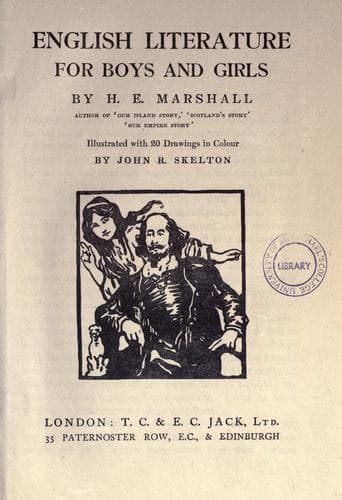
English Literature for Boys and GirlsMarshall, H. E. (Henrietta Elizabeth)
History
English Literature for Boys and Girls
Marshall, H. E. (Henrietta Elizabeth)
English literature -- History and criticism
As men count years, he was still young, for he was only forty-
seven. He had dreamed that he had still time before him to make
life a success. For as men counted success in those days,
Spenser was a failure. He had failed to make a name among the
statesmen of the age. He failed to make a fortune, he lived poor
and he died poor. As a poet he was a sublime success. He
dedicated the Faery Queen to Elizabeth "to live with the eternity
of her fame," and it is not too much to believe that even should
the deeds of Elizabeth be forgotten the fame of Spenser will
endure. And the poets of Spenser's own day knew that in him they
had lost a master, and they mourned for him as such. They buried
him in Westminster not far from Chaucer. His bier was carried by
poets, who, as they stood beside his grave, threw into it poems
in which they told of his glory and their own grief. And so they
left "The Prince of Poets in his tyme, whose divine spirit needs
no other witnesse than the workes which he left behind him."*
*The first epitaph engraved on Spenser's tomb.
BOOKS TO READ
Tales from Spenser (Told to Children Series). Una and the Red
Cross Knight, by N. G. Royde Smith (has many quotations). Tales
from the Faerie Queene, by C. L. Thomson (prose). The Faerie
Queene (verse, sixteenth century spelling). Faerie Queene, book
I, by Professor W. H. Hudson. Complete Works (Globe Edition),
edited by R. Morris. Britomart, edited by May E. Litchfield, is
the story of Britomart taken from scattered portions in books
III, IV, and V in original poetry, spelling modernized.
Chapter XLIV ABOUT THE FIRST THEATERS
IN the beginnings of our literature there were two men who, we
might say, were the fountain-heads. These were the gay minstrel
abroad in the world singing in hall and market-place, and the
patient monk at work in cell or cloister. And as year by year
our literature grew, strengthened and broadened, we might say it
flowed on in two streams. It flowed in two streams which were
ever joining, mingling, separating again, for the monk and the
minstrel spoke to man each in his own way. The monk made his
appeal to the eye as with patient care he copied, painted and
made his manuscript beautiful with gold and colors. The minstrel
made his appeal to the ear with music and with song. Then after
a time the streams seemed to join, and the monk when he played
the miracle-plays seemed to be taking the minstrel's part. Here
was an appeal to both the eye and ear. Instead of illuminating
the silent parchment he made living pictures illustrate spoken
words. Then followed a time when the streams once more divided
and church and stage parted. The strolling players and the trade
guilds took the place both of the minstrel and of the monkish
actors, the monk went back once more to his quiet cell, and the
minstrel gradually disappeared.
Public-domain text, read in full here on John Shaqi.
Reviews
Reviews
No reviews yet
Be the first to share your thoughts on this work.
Elsewhere in the archive
Join the Discussion
Join the discussion
Sign in to leave a comment or review.
Sign InorCreate an account