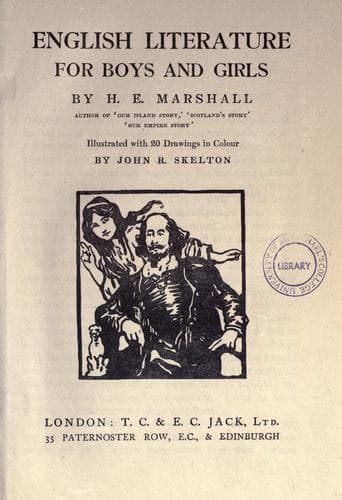
English Literature for Boys and GirlsMarshall, H. E. (Henrietta Elizabeth)
History
English Literature for Boys and Girls
Marshall, H. E. (Henrietta Elizabeth)
English literature -- History and criticism
You remember that in the Morality plays there was no scenery.
And still, although in the new plays which were now being written
the scene was supposed to change from place to place, there was
no attempt to make the stage look like these places. The stage
was merely a plain platform, and when the scene changed a board
was hung up with "This is a Palace" or "This is a Street" and the
imagination of the audience had to do the rest.
That some people felt the absurdity of this we learn from a book
by Sir Philip Sidney. In it he says, "You shall have Asia of the
one side, and Affrick of the other, and so many other under
kingdoms, that the Player, when he cometh in, must ever begin
with telling where he is, or else the tale will not be conceived.
Now you shall have three ladies walk to gather flowers, and then
we must believe the stage to be a garden. By and by, we hear
news of shipwreck in the same place, and then we are to blame if
we accept it not for a Rock. Upon the back of that, comes out a
hideous Monster, with fire and smoke, and then the miserable
beholders are bound to take it for a cave. While in the meantime
two Armies fly in, represented with four swords and bucklers, and
then what hard heart will not receive it for a pitched field!"*
*An Apologie for Poetrie, published 1595.
If the actors of the Elizabethan time had no scenery they made up
for the lack of it by splendid and gorgeous dressing. But it was
the dressing of the day. The play might be supposed to take
place in Greece or Rome or Ancient Britain, it mattered not. The
actors dressed after the fashion of their own day. And neither
actors nor audience saw anything funny in it. To them it was not
funny that an ancient British king should wear doublet and hose,
nor that his soldiers should discharge firearms in a scene
supposed to take place hundreds of years before gunpowder had
been invented. But we must remember that in those days dress
meant much more than it does now. Dress helped to tell the
story. Men then might not dress according to their likes and
dislikes, they were obliged to dress according to their rank.
Therefore it helped the Elizabethan onlooker to understand the
play when he saw a king, a courtier, or a butcher come on to the
stage dressed as he knew a king, a courtier, or a butcher
dressed. Had he seen a man of the sixth century dressed as a man
of the sixth century he would not have known to what class he
belonged and would not have understood the play nearly so well.
Public-domain text, read in full here on John Shaqi.
Reviews
Reviews
No reviews yet
Be the first to share your thoughts on this work.
Elsewhere in the archive
Join the Discussion
Join the discussion
Sign in to leave a comment or review.
Sign InorCreate an account