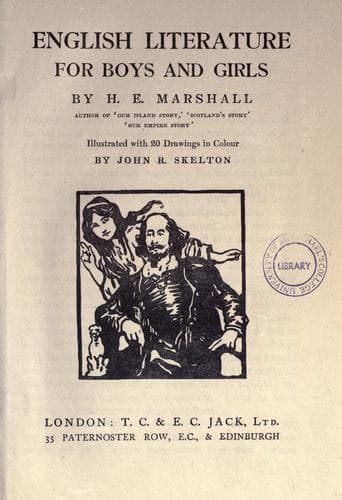
English Literature for Boys and GirlsMarshall, H. E. (Henrietta Elizabeth)
History
English Literature for Boys and Girls
Marshall, H. E. (Henrietta Elizabeth)
English literature -- History and criticism
But besides having no scenery, the people of England had at first
no theaters. Plays were acted in halls, in the dining-halls of
the great or in the guild halls belonging to the various trades.
It was not until 1575 that the first theater was built in London.
This first theater was so successful that soon another was built
and still another, until in or near London there were no fewer
than twelve. But these theaters were very unlike the theaters we
know now. They were really more like the places where people
went to see cock-fights and bear-baiting. They were round, and
except over the stage there was no roof. The rich onlookers who
could afford to pay well sat in "boxes" on the stage itself, and
the other onlookers sat or stood in the uncovered parts. Part of
a theater is still called the pit, which helps to remind us that
the first theaters may have served as "cock-pits" or "bear-pits"
too as well as theaters. For a long time, too, the theater was a
man's amusement just as bear-baiting or cock-fighting had been.
There were no actresses, the women's parts were taken by boys,
and at first ladies when they came to look on wore masks so that
they might not be known, as they were rather ashamed of being
seen at a theater.
And now that the love of plays and shows had grown so great that
it had been found worth while to build special places in which to
act, you may be sure that there was no lack of play-writers.
There were indeed many of whom I should like to tell you, but in
this book there is no room to tell of all. To show you how many
dramatists arose in this great acting age I will give you a list
of the greatest, all of whom were born between 1552 and 1585.
After Nicholas Udall and Thomas Norton and Thomas Sackville, the
writers of our first comedy and first tragedy, there came:--
George Peel. Francis Beaumont.
John Lyly. John Fletcher.
Thomas Kyd. John Webster.
Robert Greene. Philip Massinger.
Christopher Marlowe. John Ford.
William Shakespeare. Thomas Heywood.
Ben Jonson.
It would be impossible to tell you of all these, so I shall
choose only two, and first I shall tell you of the greatest of
them--Shakespeare. He shines out from among the others like a
bright star in a clear sky. He is, however, not a lonely star,
for all around him cluster others. They are bright, too, and if
he were not there we might think some of them even very bright,
yet he outshines them all. He forces our eyes to turn to him,
and not only our eyes but the eyes of the whole world. For all
over the world, wherever poetry is read and plays are played, the
name of William Shakespeare is known and reverenced.
Chapter XLV SHAKESPEARE--THE BOY
Public-domain text, read in full here on John Shaqi.
Reviews
Reviews
No reviews yet
Be the first to share your thoughts on this work.
Elsewhere in the archive
Join the Discussion
Join the discussion
Sign in to leave a comment or review.
Sign InorCreate an account