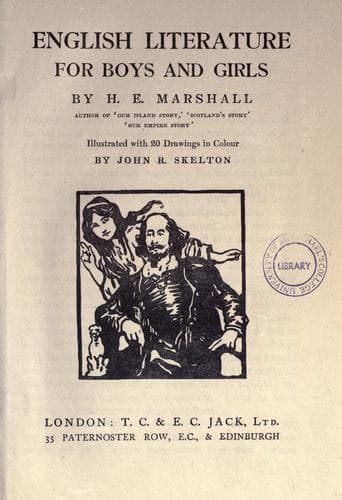
English Literature for Boys and GirlsMarshall, H. E. (Henrietta Elizabeth)
History
English Literature for Boys and Girls
Marshall, H. E. (Henrietta Elizabeth)
English literature -- History and criticism
"A whining schoolboy, with his satchel
And shining morning face, creeping like snail
Unwillingly to school."
But we do not know. And whether he liked school or not, at least
we know that later, when he came to write plays, he made fun of
schoolmasters. He knew "little Latin and less Greek,"* said a
friend in after life, but then that friend was very learned and
might think "little" that which we might take for "a good deal."
Indeed, another old writer says "he understood Latin pretty
well."**
*Ben Jonson.
**John Aubrey.
We know little either of Shakespeare's school hours or play
hours, but once or twice at least he may have seen a play or
pageant. His father went on prospering and was made chief
bailiff of the town, and while in that office he entertained
twice at least troups of strolling players, the Queen's Company
and the Earl of Worcester's Company. It is very likely that
little Will was taken to see the plays they acted. Then when he
was eleven years old there was great excitement in the country
town, for Queen Elizabeth came to visit the great Earl of
Leicester at his castle of Kenilworth, not sixteen miles away.
There were great doings then, and the Queen was received with all
the magnificence and pomp that money could procure and
imagination invent. Some of these grand shows Shakespeare must
have seen.
Long afterwards he remembered perhaps how one evening he had
stood among the crowd tiptoeing and eager to catch a glimpse of
the great Queen as she sat enthroned on a golden chair. Her red-
gold hair gleamed and glittered with jewels under the flickering
torchlight. Around her stood a crowd of nobles and ladies only
less brilliant that she. Then, as William gazed and gazed, his
eyes aching with the dazzling lights, there was a movement in the
surging crowd, a murmur of "ohs" and "ahs." And, turning, the
boy saw another lady, another Queen, appear from out the dark
shadow of the trees. Stately and slowly she moved across the
grass. Then following her came a winged boy with golden bow and
arrows. This was the god of Love, who roamed the world shooting
his love arrows at the hearts of men and women, making them love
each other. He aimed, he shot, the arrow flew, but the god
missed his aim and the lady passed on, beautiful, cold, free, as
before. Love could not touch her, he followed her but in vain.
It was with such pageants, such allegories, that her people
flattered Queen Elizabeth, for many men laid their hearts at her
feet, but she in return never gave her own. She was the woman
above all others to be loved, to be worshiped, but herself
remained in "maiden meditation fancy-free." The memory of those
brilliant days stayed with the poet-child. They were sun-gilt,
as childish memories are, and in after years he wrote:
Public-domain text, read in full here on John Shaqi.
Reviews
Reviews
No reviews yet
Be the first to share your thoughts on this work.
Elsewhere in the archive
Join the Discussion
Join the discussion
Sign in to leave a comment or review.
Sign InorCreate an account