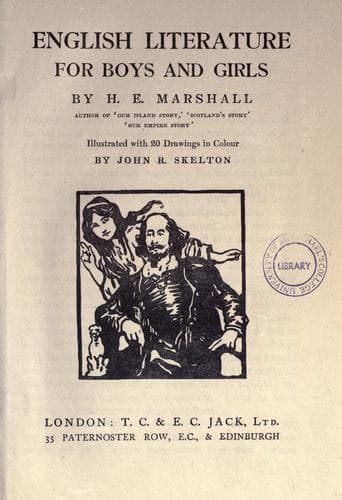
English Literature for Boys and GirlsMarshall, H. E. (Henrietta Elizabeth)
History
English Literature for Boys and Girls
Marshall, H. E. (Henrietta Elizabeth)
English literature -- History and criticism
"That very time I saw (but thou couldst not)
Flying between the cold moon and the earth,
Cupid all arm'd. A certain aim he took
At a fair vestal, throned by the West,
And loos'd his love-shaft smartly from his bow,
As it should pierce a hundred thousand hearts;
But I might see young cupid's fiery shaft
Quench'd in the chaste beams of the watery moon,
And the imperial votaress passed on,
In maiden meditation, fancy-free.
Yet mark'd I where the bolt of Cupid fell:
It fell upon a little western flower;
Before, milk-white; now, purple with love's wound,
And maidens call it love-in-idleness."*
*Midsummer Night's Dream, Act II Scene i.
Some time after John Shakespeare became chief bailiff his
fortunes turned. From being rich he became poor. Bit by bit he
was obliged to sell his own and his wife's property. So little
Will was taken away from school at the age of thirteen, and set
to earn his own living as a butcher--his father's trade, we are
told. But if he ever was a butcher he was, nevertheless, an
actor and a poet, "and when he killed a calf he would do it in a
high style and make a speech."* How Shakespeare fared in this
new work we do not know, but we may fancy him when work was done
wandering along the pretty country lanes or losing himself in the
forest of Arden, which lay not far from his home, "the poet's eye
in a fine frenzy rolling," and singing to himself:
"Jog on, jog on, the footpath way,
And merrily hent the stile-a;
A merry heart goes all the day,
Your sad tires in a mile-a."*
*Winter's Tale, Act IV Scene ii.
*John Aubrey.
He knew the lore of fields and woods, of trees and flowers, and
birds and beasts. He sang of
"The ousel-cock so black of hue,
With orange-tawny bill,
The throstle with his note so true,
The wren with little quill.
The finch, the sparrow, and the lark,
The plain-song cuckoo gray,
Whose note full many a man doth mark,
And dares not answer nay."*
*Midsummer Night's Dream, Act III Scene i.
He remembered, perhaps, in after years his rambles by the slow-
flowing Avon, when he wrote:
"He makes sweet music with th' enamell'd stones,
Giving a gentle kiss to every sedge
He overtaketh in his pilgrimage;
And so by many winding nooks he strays,
With willing sport, to the wide ocean."*
*Two Gentlemen of Verona, Act II Scene vii.
He knew the times of the flowers. In spring he marked
"the daffodils,
That come before the swallow dares, and take
The winds of March with beauty."*
*Winter's Tale.
Of summer flowers he tells us
"Hot lavender, mints, savory, marjoram;
The marigold, that goes to bed wi' the sun,
And with him rises weeping; these are flowers
Of middle summer."*
*Winter's Tale.
Public-domain text, read in full here on John Shaqi.
Reviews
Reviews
No reviews yet
Be the first to share your thoughts on this work.
Elsewhere in the archive
Join the Discussion
Join the discussion
Sign in to leave a comment or review.
Sign InorCreate an account