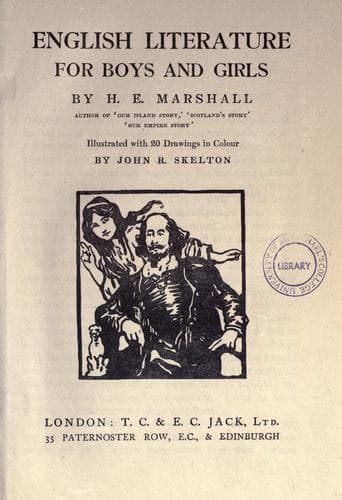
English Literature for Boys and GirlsMarshall, H. E. (Henrietta Elizabeth)
History
English Literature for Boys and Girls
Marshall, H. E. (Henrietta Elizabeth)
English literature -- History and criticism
WHEN Shakespeare first went to London he had a hard life. He
found no better work to do than that of holding horses outside
the theater doors. In those days the plays took place in the
afternoon, and as many of the fine folk who came to watch them
rode on horseback, some one was needed to look after the horses
until the play was over. But poor though this work was,
Shakespeare seems to have done it well, and he became such a
favorite that he had several boys under him who were long known
as "Shakespeare's boys." Their master, however, soon left work
outside the theater for work inside. And now began the busiest
years of his life, for he both acted and wrote. At first it may
be he only altered and improved the plays of others. But soon he
began to write plays that were all his own. Yet Shakespeare,
like Chaucer, never invented any of his own stories. There is
only one play of his, called Love's Labor's Lost, the story of
which is not to be found in some earlier book. That, too, may
have been founded on another story which is now lost.
When you come to know Shakespeare's plays well you will find it
very interesting to follow his stories to their sources. That of
King Lear, which is one of Shakespeare's great romantic
historical plays, is, for instance, to be found in Geoffrey of
Monmouth, in Wace's Brut, and in Layamon's Brut. But it was from
none of these that Shakespeare took the story, but from the
chronicle of a man named Holinshed who lived and wrote in the
time of Queen Elizabeth, he in his turn having taken it from some
one of the earlier sources.
For, after all, in spite of the thousands of books that have been
written since the world began, there are only a certain number of
stories which great writers have told again and again in varying
ways. One instance of this we saw when in the beginning of this
book we followed the story of Arthur.
But although Shakespeare borrowed his plots from others, when he
had borrowed them he made them all his own. He made his people
so vivid and so true that he makes us forget that they are not
real people. We can hardly realize that they never lived, that
they never walked and talked, and cried and laughed, loved and
hated, in this world just as we do. And this is so because the
stage to him is life and life a stage. "All the world's a
stage," he says,
"And all the men and women merely players:
They have their exits and their entrances:
And one man in his time plays many parts,
His acts being seven ages."*
*As You Like It.
And again he tells us:
"Life's but a walking shadow; a poor player,
That struts and frets his hour upon the stage
And then is heard no more."*
*Macbeth.
Public-domain text, read in full here on John Shaqi.
Reviews
Reviews
No reviews yet
Be the first to share your thoughts on this work.
Elsewhere in the archive
Join the Discussion
Join the discussion
Sign in to leave a comment or review.
Sign InorCreate an account