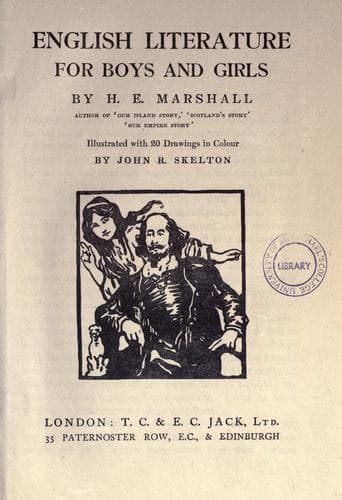
English Literature for Boys and GirlsMarshall, H. E. (Henrietta Elizabeth)
History
English Literature for Boys and Girls
Marshall, H. E. (Henrietta Elizabeth)
English literature -- History and criticism
It is from Shakespeare's works that we get the clearest picture
of Elizabethan times. And yet, although we learn from him so
much of what people did in those days, of how they talked and
even of how they thought, the chief thing that we feel about
Shakespeare's characters is, not that they are Elizabethan, but
that they are human, that they are like ourselves, that they
think, and say, and do, things which we ourselves might think,
and say, and do.
There are many books we read which we think of as very pretty,
very quaint, very interesting--but old-fashioned. But
Shakespeare can never be old-fashioned, because, although he is
the outcome of his own times, and gives us all the flavor of his
own times, he gives us much more. He understood human nature, he
saw beneath the outward dress, and painted for us real men and
women. And although fashion in dress and modes of living may
change, human nature does not change. "He was not of an age but
for all time," it was said of him about seven years after his
death, and now that nearly three hundred years have come and gone
we still acknowledge the truth of those words.
Shakespeare's men and women speak and act and feel in the main as
we might now. Many of his people we feel are our brothers and
sisters. And to this human interest he adds something more, for
he leads us too through "unpathed waters" to "the undreamed
shores" of fairyland.
Shakespeare's writing time was short. Before he left Stratford
he wrote nothing unless it may have been a few scoffing verses
against the Justice of the Peace who punished him for poaching.
But these, if they were ever written, are lost. In the last few
years of his life he wrote little or nothing. Thus the number of
his writing years was not more than twenty to twenty-five, but in
that time he wrote thirty-seven plays, two long poems, and a
hundred and fifty-six sonnets. At one time he must have written
two plays every year. And when you come to know these plays well
you will wonder at the greatness of the task.
Shakespeare writes his plays sometimes in rime, sometimes in
blank verse, sometimes in prose, at times using all these in one
play. In this he showed how free he was from rules. For, until
he wrote, plays had been written in rime or blank verse only.
For the sake of convenience Shakespeare's plays have been divided
into histories, tragedies and comedies. But it is not always
easy to draw the line and decide to which class a play belongs.
They are like life. Life is not all laughter, nor is it all
tears. Neither are Shakespeare's comedies all laughter, and some
of his tragedies would seem at times to be too deep for tears,
full only of fierce, dark sorrow--and yet there is laughter in
them too.
Public-domain text, read in full here on John Shaqi.
Reviews
Reviews
No reviews yet
Be the first to share your thoughts on this work.
Elsewhere in the archive
Join the Discussion
Join the discussion
Sign in to leave a comment or review.
Sign InorCreate an account