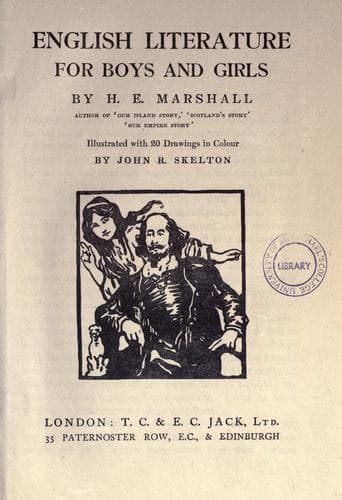
English Literature for Boys and GirlsMarshall, H. E. (Henrietta Elizabeth)
History
English Literature for Boys and Girls
Marshall, H. E. (Henrietta Elizabeth)
English literature -- History and criticism
And so although outside his work we get only glimpses of the man,
these glimpses taken together with his writings show us Will
Shakespeare as a big-hearted man, a man who understood all and
forgave all. He understood the little joys and sorrows that make
up life. He understood the struggle to be good, and would not
scorn people too greatly when they were bad. "Children, we feel
sure," says one of the latest writers about him, "did not stop
their talk when he came near them, but continued in the happy
assurance that it was only Master Shakespeare."* And so if
children find his plays hard to read yet a while they may at
least learn to know his stories and learn to love his name--it is
only Master Shakespeare. But they must remember that learning to
know Shakespeare's stories through the words of other people is
only half a joy. The full joy of Shakespeare can only come when
we are able to read his plays in his very own words. But that
will come all the more easily and quickly to us if we first know
his stories well.
*Prof. Raleigh.
There are parts in some of Shakespeare's plays that many people
find coarse. But Shakespeare is not really coarse. We remember
the vision sent to St. Peter which taught him that there was
nothing common or unclean. Shakespeare had seen that vision. In
life there is nothing common or unclean, if we only look at it in
the right way. And Shakespeare speaks of everything that touches
life most nearly. He uses words that we do not use now; he
speaks of things we do not speak of now; but it was the fashion
of his day to be more open and plain spoken than we are. And if
we remember that, there is very little in Shakespeare that need
hurt us even if there is a great deal which we cannot understand.
And when you come to read some of the writers of Shakespeare's
age and see that in them the laughter is often brutal, the horror
of tragedy often coarse and crude, you will wonder more than ever
how Shakespeare made his laughter so sweet and sunny, and how,
instead of revolting us, he touches our hearts with his horror
and pain.
About eleven years passed after Shakespeare left Stratford before
he returned there again. But once having returned, he often paid
visits to his old home. And he came now no more as a poor wild
lad given to poaching. He came as a man of wealth and fame. He
bought the best house in Stratford, called New Place, as well as
a good deal of land. So before John Shakespeare died he saw his
family once more important in the town.
Public-domain text, read in full here on John Shaqi.
Reviews
Reviews
No reviews yet
Be the first to share your thoughts on this work.
Elsewhere in the archive
Join the Discussion
Join the discussion
Sign in to leave a comment or review.
Sign InorCreate an account