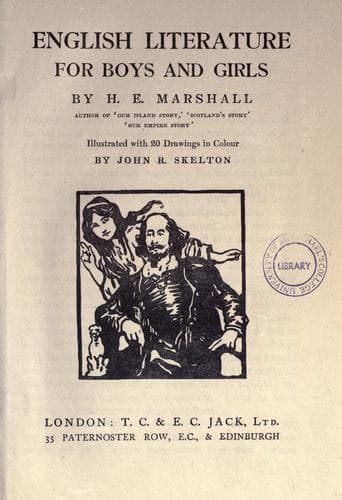
English Literature for Boys and GirlsMarshall, H. E. (Henrietta Elizabeth)
History
English Literature for Boys and Girls
Marshall, H. E. (Henrietta Elizabeth)
English literature -- History and criticism
Then as the years went on Shakespeare gave up all connection with
London and the theater and settled down to a quiet country life.
He planted trees, managed his estate, and showed that though he
was the world's master-poet he was a good business man too.
Everything prospered with him, his two daughters married well,
and comfortably, and when not more than forty-three he held his
first grandchild in his arms. It may be he looked forward to
many happy peaceful years when death took him. He died of fever,
brought on, no doubt, by the evil smells and bad air by which
people lived surrounded in those days before they had learned to
be clean in house and street.
Shakespeare was only fifty-two when he died. It was in the
springtime of 1616 that he died, breathing his last upon
"The uncertain glory of an April day
Which now shows all the beauty of the sun
And by and by a cloud takes all away."*
*Two Gentlemen of Verona.
He was buried in Stratford Parish Church, and on his grave was
placed a bust of the poet. That bust and an engraving in the
beginning of the first great edition of his works are the only
two real portraits of Shakespeare. Both were done after his
death, and yet perhaps there is no face more well known to us
than that of the greatest of all poets.
Beneath the bust are written these lines:
"Stay, passenger, why goest thou by so fast?
Read, if thou-canst, whom envious Death hath plast
Within this monument; Shakespeare with whome
Quick nature dide: whose name doth deck ys tombe,
Far more than cost, sith all yt he hath writt,
Leaves living art but page to serve his witt."
Upon a slab over the grave is carved:
"Good frend, for Jesus' sake forbeare
To digg the dust encloased heare;
Bleste be ye man yt spares thes stones,
And curst be he yt moves my bones."
And so our greatest poet lies not beneath the great arch of
Westminster but in the quiet church of the little country town in
which he was born.
Chapter LXVII SHAKESPEARE--"THE MERCHANT OF VENICE"
IN this chapter I am going to tell you in a few words the story
of one of Shakespeare's plays called The Merchant of Venice. It
is founded on an Italian story, one of a collection made by Ser
Giovanni Fiorentino.
The merchant of Venice was a rich young man called Antonio. When
the story opens he had ventured all his money in trading
expeditions to the East and other lands. In two months' time he
expects the return of his ships and hopes then to make a great
deal of money. But meantime he has none to spare, and when his
great friend Bassanio comes to borrow of him he cannot give him
any.
Public-domain text, read in full here on John Shaqi.
Reviews
Reviews
No reviews yet
Be the first to share your thoughts on this work.
Elsewhere in the archive
Join the Discussion
Join the discussion
Sign in to leave a comment or review.
Sign InorCreate an account