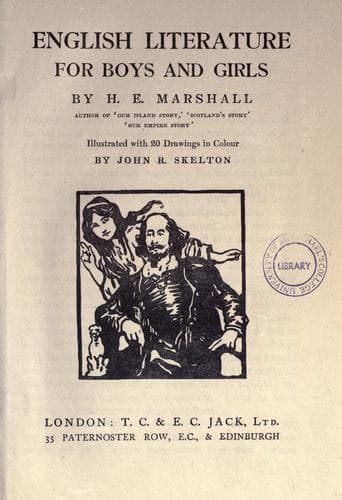
English Literature for Boys and GirlsMarshall, H. E. (Henrietta Elizabeth)
History
English Literature for Boys and Girls
Marshall, H. E. (Henrietta Elizabeth)
English literature -- History and criticism
So finding nowhere love or sympathy but everywhere only mockery
and cruel laughter, Shylock vows vengeance. The world has
treated him ill, and he will repay the world with ill, and
chiefly against Antonio does his anger grow bitter.
Then Antonio's friends shake their heads and say, "Let him beware
the hatred of the Jew." They look gravely at each other, for it
is whispered abroad that "Antonio hath a ship of rich lading
wreck'd on the narrow seas."
Then let Antonio beware.
"Thou wilt not take his flesh," says one of the young merchant's
friends to Shylock. "What's that good for?"
"To bait fish withal," snarls the Jew. "If it will feed nothing
else it will feed my revenge. He hath disgraced me, and hindered
me half a million; laughed at my losses, mocked at my gains,
scorned my nation, thwarted my bargains, cooled my friends,
heated mine enemies; and what's his reason? I am a Jew. Hath
not a Jew eyes? Hath not a Jew hands, organs, dimensions,
senses, affections, passions? Fed with the same food, hurt with
the same weapons, subject to the same diseases, healed by the
same means, warmed and cooled by the same winter and summer, as a
Christian is? If you prick us, do we not bleed? If you tickle
us, do we not laugh? If you poison us, do we not die? If you
wrong us, shall we not revenge? If we are like you in the rest,
we will resemble you in that. If a Jew wrong a Christian, what
is his humility? Revenge. If a Christian wrong a Jew, what
should his sufferance be by Christian example? Why, revenge.
The villainy you teach me, I will execute, and it shall go hard
but I will better the instruction."
Then let Antonio beware.
Meantime in Belmont many lovers come to woo fair Portia. With
high hope they come, with anger and disappointment they go away.
None can win the lady's hand. For there is a riddle here of
which none know the meaning.
When a suitor presents himself and asks for the lady's hand in
marriage, he is shown three caskets, one of gold, one of silver,
and one of lead. Upon the golden one is written the words, "Who
chooseth me, shall gain what many men desire"; upon the silver
casket are the words, "Who chooseth me, shall get as much as he
deserves"; and upon the leaden one, "Who chooseth me, must give
and hazard all he hath." And only whoso chooseth aright, each
suitor is told, can win the lady.
This trial of all suitors had been ordered by Portia's father ere
he died, so that only a worthy and true man might win his
daughter. Some suitors choose the gold, some the silver casket,
but all, princes, barons, counts, and dukes, alike choose wrong.
At length Bassanio comes. Already he loves Portia and she loves
him. There is no need of any trail of the caskets. Yet it must
be. Her father's will must be obeyed. But what if he choose
wrong. That is Portia's fear.
"I pray you, tarry; pause a day or two
Before you hazard; for, in choosing wrong,
I lose your company,"
she says.
Public-domain text, read in full here on John Shaqi.
Reviews
Reviews
No reviews yet
Be the first to share your thoughts on this work.
Elsewhere in the archive
Join the Discussion
Join the discussion
Sign in to leave a comment or review.
Sign InorCreate an account