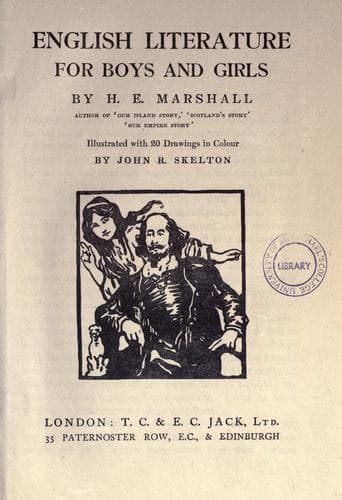
English Literature for Boys and GirlsMarshall, H. E. (Henrietta Elizabeth)
History
English Literature for Boys and Girls
Marshall, H. E. (Henrietta Elizabeth)
English literature -- History and criticism
But Bassanio cannot wait:--
"Let me choose;
For, as I am, I live upon the rack."
And so he stands before the caskets, longing to make a choice,
yet fearful. The gold he rejects, the silver too, and lays his
hand upon the leaden casket. He opens it. Oh, joy! within is a
portrait of his lady. He has chosen aright. yet he can scarce
believe his happiness.
"I am," he says,
"Like one of two contending in a prize,
That thinks he hath done well in people's eyes,
Hearing applause, and universal shout,
Giddy in spirit, still gazing in a doubt
Whether those pearls of praise be his or no;
So, thrice fair lady, stand I, even so;
As doubtful whether what I see be true,
Until confirm'd, sign'd, ratifi'd by you."
And Portia, happy, triumphant, humble, no longer the great lady
with untold wealth, with lands and palaces and radiant beauty,
but merely a woman who has given her love, answers:--
"You see me, Lord Bassanio, where I stand,
Such as I am: though, for myself alone,
I would not be ambitious in my wish,
To wish myself much better; yet, for you,
I would be trebled twenty times myself;
A thousand times more fair, ten thousand times
More rich;
That only to stand high on your account,
I might in virtues, beauties, livings, friends,
Exceed account: but the full sum of me
Is sum of something: which, to term in gross,
Is an unlesson'd girl, unschool'd, unpractis'd,
Happy in this, she is not yet so old
But she may learn; happier than this,
She is not bred so dull but she can learn;
Happiest of all, is, that her gentle spirit
Commite itself to yours to be directed,
As from her lord, her governor, her king.
Myself, and what is mine, to you, and yours
Is now converted; but now I was the lord
Of this fair mansion, master of my servants,
Queen o'er myself; and even now, but now,
This house, these servants, and this same myself,
Are yours, my lord."
Then as a pledge of all her love Portia gives to Bassanio a ring,
and bids him never part from it so long as he shall live. And
Bassanio taking it, gladly swears to keep it forever.
"But when this ring
Parts from this finger, then parts life from hence;
O, then be bold to say, Bassanio's dead."
And then as if to make the joy complete, it is discovered that
Portia's lady in waiting, Nerissa, and Bassanio's friend,
Gratiano, also love each other, and they all agree to be married
on the same day.
In the midst of this happiness the runaway couple, Lorenzo and
Jessica, arrive from Venice with another of Antonio's friends who
brings a letter to Bassanio. As Bassanio reads the letter all
the gladness fades from his face. He grows pale and trembles.
Anxiously Portia asks what troubles him.
"I am half yourself,
And I must freely have the half of anything
That this same paper brings you."
And Bassanio answers:--
Public-domain text, read in full here on John Shaqi.
Reviews
Reviews
No reviews yet
Be the first to share your thoughts on this work.
Elsewhere in the archive
Join the Discussion
Join the discussion
Sign in to leave a comment or review.
Sign InorCreate an account