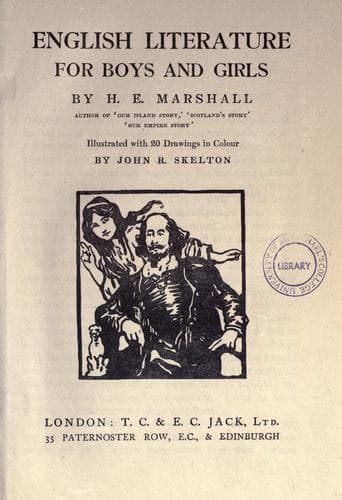
English Literature for Boys and GirlsMarshall, H. E. (Henrietta Elizabeth)
History
English Literature for Boys and Girls
Marshall, H. E. (Henrietta Elizabeth)
English literature -- History and criticism
Thomas Fuller, who wrote the book in which this story is found,
was only a boy of ten when Raleigh died, so he could not have
known the great man himself, but he must have heard many stories
about him from those who had, and we need not disbelieve this
one. It is one of those things which might very well have
happened even if it did not.
And whether Raleigh first came into Queen Elizabeth's notice in
this manner or not, after he did become known to her, he soon
rose in her favor. He rose so quickly that he almost feared the
giddy height to which he rose. According to another story of
Fuller's, "This made him write in a glasse window, obvious to the
Queen's eye,
'Fain would I climb, yet fear I to fall.'
"Her Majesty, either espying or being shown it, did underwrite:
'If thy heart fails thee, climb not at all.'
"However he at last climbed up by the stairs of his own desert."
Honors and favors were heaped upon Raleigh, and from being a poor
soldier and country gentleman he became rich and powerful, the
lord of lands in five counties, and Captain of the Queen's Own
Body-Guard. Haughty of manner, splendid in dress, loving jewels
more than even a woman does, Raleigh became as fine a courtier as
he was a brave soldier. But soldier though Raleigh was, courtier
though he was, loving ease and wealth and fine clothes, he was at
heart a sailor and adventurer, and the sea he had loved as a boy
called to him.
Like many another of his age Raleigh, hearing the call of the
waves ever in his ears, felt the desire to explore tug at his
heart-strings. For in those days America had been discovered,
and the quest for the famous North-West passage had begun. And
Raleigh longed to set forth with other men to conquer new worlds,
to find new paths across the waves. But above all he longed to
fight the Spaniards, who were the great sea kings of those days.
Raleigh however could not be a courtier and a sailor at one and
the same time. He was meanwhile high in the Queen's favor, and
she would not let him go from her. So all that Raleigh could do,
was to venture his money, and fit out a ship to which he gave his
own name. This he sent to sail along with others under the
command of his step-brother Sir Humphrey Gilbert, who was setting
out upon a voyage of discovery. It was on this voyage that Sir
Humphrey found and claimed Newfoundland as an English possession,
setting up there "the Arms of England ingraven in lead and
infixed upon a pillar of wood."* But the expedition was
unfortunate, most of the men and ships were lost, Sir Humphrey
himself being drowned on his way home. He was brave and fearless
to the last. "We are as near to Heaven by sea as by land," he
said, a short time before his ship went down. One vessel only
"in great torment of weather and peril of drowning"* reached home
safely, "all the men tired with the tediousness of so
unprofitable a voyage to their seeming." Yet though they knew it
Public-domain text, read in full here on John Shaqi.
Reviews
Reviews
No reviews yet
Be the first to share your thoughts on this work.
Elsewhere in the archive
Join the Discussion
Join the discussion
Sign in to leave a comment or review.
Sign InorCreate an account