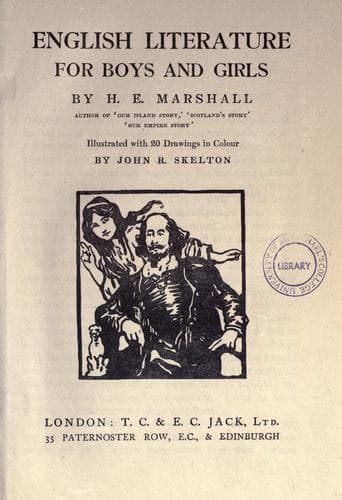
English Literature for Boys and GirlsMarshall, H. E. (Henrietta Elizabeth)
History
English Literature for Boys and Girls
Marshall, H. E. (Henrietta Elizabeth)
English literature -- History and criticism
not they had helped to lay the foundation of Greater Britain.
*Hakluyt's Voyages.
Nothing daunted by this loss, six months later Raleigh sent out
another expedition. This time it was to the land south of
Newfoundland that the ships took their way. There they set up
the arms of England, and named the new possession Virginia in
honor of the virgin Queen. This expedition was little more
successful than Sir Humphrey Gilbert's, but nothing seemed to
discourage Raleigh. He was bent on founding a colony, and again
and yet again he sent out ships and men, spending all the wealth
which the Queen heaped upon him in trying to extend her dominions
beyond the seas. Hope was strong within him. "I shall yet live
to see it an English nation," he said.
And while Raleigh's captains tried to found a new England in the
New World, Raleigh himself worked at home to bring order into the
vast estates the Queen had given to him in Ireland. This land
had belonged to the rebel Earl of Desmond. At one time no doubt
it had been fertile, but rebellion and war had laid it waste.
"The land was so barren both of man and beast that whosoever did
travel from one end of all Munster . . . . he should not meet
man, woman, or child, saving in cities or towns, nor yet see any
beast, save foxes, wolves, or the ravening beasts." And barren
and desolate as it was when Raleigh received it, it soon became
known as the best tilled land in all the country-side. For he
brought workers and tenants from his old Devon home to take the
place of the beggared or slain Irish. He introduced new and
better ways of tilling, and also he brought to Ireland a strange
new root. For it is interesting to remember that it was in
Raleigh's Irish estates that potatoes were first grown in our
Islands.
Raleigh took a great interest in these estates, so perhaps it was
not altogether a hardship to him, finding himself out of favor
with his Queen, to go to Ireland for a time. And although they
had known each other before, it was then that his friendship with
Spenser began. Spenser read his Faery Queen to Raleigh, and
perhaps Raleigh read to Spenser his poem Cynthia written in honor
of Queen Elizabeth. But of that poem nearly all has been lost.
Elizabeth was not as yet very angry with Raleigh, still he felt
the loss of her favor, for Spenser tells us:--
"His song was all a lamentable lay,
Of great unkindness and of usage hard,
Of Cynthia, the Lady of the Sea,
Which from her presence faultless him debarred.
And ever and anon with singults* rife,
He criéd out, to make his undersong,
'Ah! my love's Queen, and goddess of my life,
Who shall me pity when thou doest me wrong?'"**
*Sobs.
**"Colin Clout's come home again."
But Raleigh soon decided to return to court, and persuaded
Spenser
"To wend with him his Cynthia to see,
Whose grace was great and bounty most rewardful"*
*Colin Clout.
Public-domain text, read in full here on John Shaqi.
Reviews
Reviews
No reviews yet
Be the first to share your thoughts on this work.
Elsewhere in the archive
Join the Discussion
Join the discussion
Sign in to leave a comment or review.
Sign InorCreate an account