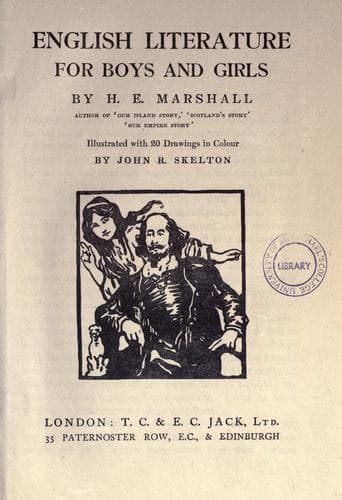
English Literature for Boys and GirlsMarshall, H. E. (Henrietta Elizabeth)
History
English Literature for Boys and Girls
Marshall, H. E. (Henrietta Elizabeth)
English literature -- History and criticism
WHEN we are little, there are many things we cannot understand;
we puzzle about them a good deal perhaps, and then we ask
questions. And sometimes the grown-ups answer our question and
make the puzzling things clear to us, sometimes they answer yet
do not make the puzzling things any clearer to us, and sometimes
they tell us not to trouble, that we will understand when we grow
older. Then we wish we could grow older quick, for it seems such
a long time to wait for an answer. But worst of all, sometimes
the grown-ups tell us not to talk so much and not to ask so many
question.
The fact is, though perhaps I ought not to tell you, grown-ups
don't know everything. That is not any disgrace either, for of
course no one can know everything, not even father or mother.
And just as there are things which puzzle little folks, there are
things which puzzle big folks. And just as among little folks
there are some who ask more questions and who "want to know" more
than others, so among grown-ups there are some who more than
others seek for the answer to those puzzling question. These
people we call philosophers. The word comes from two Greek
words, philos loving, sophos wise, and means loving wisdom. In
this chapter I am going to tell you about Francis Bacon, the
great philosopher who lived in the times of Elizabeth and James.
I do not think that I can quite make you understand what
philosophy really means, or what his learned books were about,
nor do I think you will care to read them for a long time to
come. But you will find the life of Francis Bacon very
interesting. It is well, too, to know about Bacon, for with him
began a new kind of search for wisdom. The old searchers after
truth had tried to settle the questions which puzzled them by
turning to imaginary things, and by mere thinking. Bacon said
that we must answer these questions by studying not what was
imaginary, but what was real--by studying nature. So Bacon was
not only a lover of truth but was also the first of our
scientists of to-day. Scientist comes from the Latin word scio
to know, and Science means that which we know by watching things
and trying things,--by making experiments. And although Bacon
did not himself find out anything new and useful to man, he
pointed out the road upon which others were to travel.
Public-domain text, read in full here on John Shaqi.
Reviews
Reviews
No reviews yet
Be the first to share your thoughts on this work.
Elsewhere in the archive
Join the Discussion
Join the discussion
Sign in to leave a comment or review.
Sign InorCreate an account