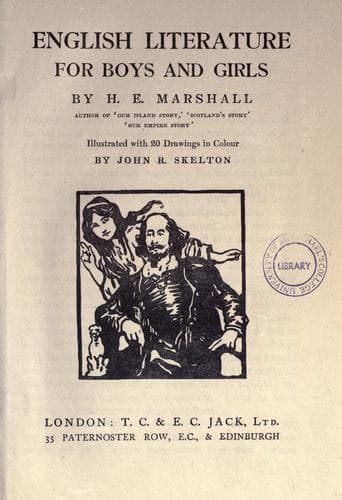
English Literature for Boys and GirlsMarshall, H. E. (Henrietta Elizabeth)
History
English Literature for Boys and Girls
Marshall, H. E. (Henrietta Elizabeth)
English literature -- History and criticism
A year later Raleigh returned. But he returned without his son,
with hopes broken, fortune lost. Many fights and storms had he
endured, many hardships suffered, but he had not found the Golden
City. His money was spent, his ships shattered, his men in
mutiny, and hardest of all to bear, his young son Walter lay dead
in far Guiana, slain in a fight with Spaniards. How Raleigh
grieved we learn from his letter to his wife, "I was loath to
write," he says, "because I knew not how to comfort you; and, God
knows, I never knew what sorrow meant till now. . . . Comfort
your heart, dearest Bess, I shall sorrow for us both, I shall
sorrow less because I have not long to sorrow, because not long
to live. . . . I have written but that letter, for my brains are
broken, and it is a torment for me to write, and especially of
misery. . . . The Lord bless and comfort you that you may bear
patiently the death of your most valiant son."
Raleigh came home a sad and ruined man, and had the pity of the
King been as easily aroused as his fear of the Spaniards he had
surely been allowed to live out the rest of his life in peaceful
quiet. But James, who shuddered at the sight of a drawn sword,
feared the Spaniards and had patched up an imaginary peace with
them. And now when the Spanish Ambassador rushed into the King's
Chamber crying "Pirates! Pirates!" Raleigh's fate was sealed.
Raleigh had broken the peace in land belonging to "our dear
brother the King of Spain" said James, therefore he must die.
Thus once again, Raleigh found himself lodged in the Tower. But
so clearly did he show that he had broken no peace where no peace
was, that it was found impossible to put him to death because of
what he had done in Guiana. He was condemned to death,
therefore, on the old charge of treason passed upon him nearly
fifteen years before. He met death bravely and smiling. Clad in
splendid clothes such as he loved, he mounted the scaffold and
made his farewell speech to those around.
"'Tis a sharp medicine, but it is a sound cure for all diseases,"
he said smiling to the Sheriff as he felt the edge of the ax.
Then he laid his head upon the block.
"Thus," says the first writer of Raleigh's life, "have we seen
how Sir Walter Raleigh who had been one of the greatest scourges
of Spain, was made a sacrifice to it."
"So may we say to the memory of this worthy knight," says Fuller,
"'Repose yourself in this our Catalogue under what topic you
please, statesman, seaman, soldier, learned writer or what not.'
His worth unlocks our cabinets and proves both room and welcome
to entertain him . . . so dexterous was he in all his
undertakings in Court, in camp, by sea, by land, with sword, with
pen."*
*Fuller's Worthies.
BOOKS TO READ
Westward Ho! by Charles Kingsley may be read in illustration of
this chapter.
Chapter LII BACON--NEW WAYS OF WISDOM
Public-domain text, read in full here on John Shaqi.
Reviews
Reviews
No reviews yet
Be the first to share your thoughts on this work.
Elsewhere in the archive
Join the Discussion
Join the discussion
Sign in to leave a comment or review.
Sign InorCreate an account