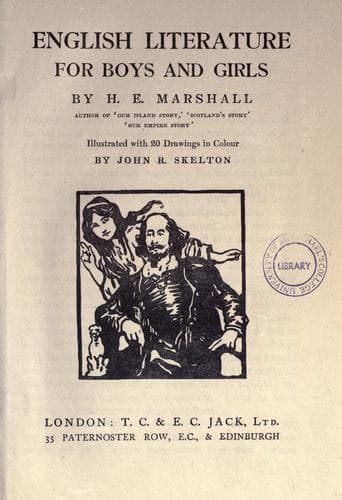
English Literature for Boys and GirlsMarshall, H. E. (Henrietta Elizabeth)
History
English Literature for Boys and Girls
Marshall, H. E. (Henrietta Elizabeth)
English literature -- History and criticism
But one friend at court he found in the Earl of Essex, the
favorite of Elizabeth, the rival of Raleigh. Essex, however, who
could win so much favor for himself, could win none for Francis
Bacon. Being able to win nothing from the Queen, on his own
account Essex gave his friend an estate worth about 1800 pounds.
But although that may have been some comfort to Bacon, it did not
win for him greatness in the eyes of the world, the only greatness
for which he longed. As to the Queen, she made use of him when
it pleased her, but she had no love for him. "Though she cheered
him much with the bounty of her countenance," says an early
writer of Bacon's life, his friend and chaplain,* "yet she never
cheered him with the bounty of her hand." It was, alas, that
bounty of the hand that Bacon begged for and stooped for all
through his life. Yet he cared nothing for money for its own
sake, for what he had, he spent carelessly. He loved to keep
high state, he loved grandeur, and was always in debt.
* William Rawley.
Essex through all his brilliant years when the Queen smiled upon
him stuck by his friend, for him he spent his "power, might,
authority and amity" in vain. When the dark hours came and Essex
fell into disgrace, it was Bacon who forgot his friendship.
You will read in history-books of how Essex, against the Queen's
orders, left Ireland, and coming to London, burst into her
presence one morning before she was dressed. You will read of
how he was disgraced and imprisoned. At first Bacon did what he
could for his friend, and it was through his help that Essex was
set free. But even then, Bacon wrote to the Earl, "I confess I
love some things much better than I love your lordship, as the
Queen's service, her quiet and contentment, her honour, her
favour, the good of my country, and the like. Yet I love few
persons better than yourself, both for gratitude's sake, and for
your own virtues."
Set free, Essex rushed into passionate, futile rebellion. Again
he was made prisoner and tried for high treason. It was then
that Bacon had to choose between friend and Queen. He chose his
Queen and appeared in court against his friend. To do anything
else, Bacon told himself, had been utterly useless. Essex was
now of no more use to him, he was too surely fallen. To cling to
him could do not good, but would only bring the Queen's anger
upon himself also. And yet he had written: "It is friendship
when a man can say to himself, I love this man without respect of
utility. . . . I make him a portion of my own wishes."
He wrote that as a young man, later he saw nothing in friendship
beyond use.
Public-domain text, read in full here on John Shaqi.
Reviews
Reviews
No reviews yet
Be the first to share your thoughts on this work.
Elsewhere in the archive
Join the Discussion
Join the discussion
Sign in to leave a comment or review.
Sign InorCreate an account