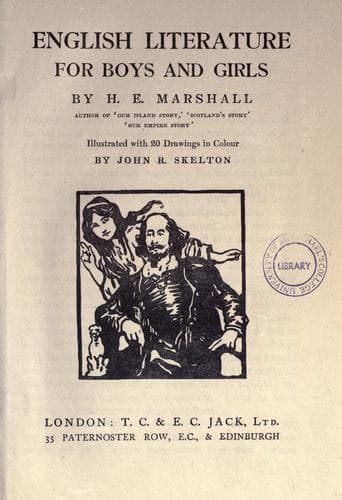
English Literature for Boys and GirlsMarshall, H. E. (Henrietta Elizabeth)
History
English Literature for Boys and Girls
Marshall, H. E. (Henrietta Elizabeth)
English literature -- History and criticism
The trial of Essex must have been a brilliant scene. The Earl
himself, young, fair of face, splendidly clad, stood at the bar.
He showed no fear, his bearing was as proud and bold as ever,
"but whether his courage were borrowed and put on for the time or
natural, it were hard to judge."* The Lord Treasurer, the Lord
High Steward, too were there and twenty-five peers, nine earls,
and sixteen barons to try the case. Among the learned counsel
sat Bacon, a disappointed man of forty. There was nothing to
single him out from his fellows save that he was the Earl's
friend, and as such might be looked upon to do his best to save
him.
*John Chamberlain.
As the trial went on, however, Bacon spoke, not to save, but to
condemn. Did no memory of past kindliness cross his mind as he
likened his friend to "Cain, that first murderer," as he
complained to the court that too much favor was shown to the
prisoner, that he had never before heard "so ill a defense of
such great and notorious treasons." The Earl answered in his own
defense again and yet again. But at length he was silent. His
case was hopeless, and he was condemned to death. He was
executed on 25th February, 1601.
Perhaps Bacon could not have saved his friend from death, but had
he used his wit to try at least to save instead of helping to
condemn, he would have kept his own name from a dark blot. But a
greater betrayal of friendship was yet to follow. Though Essex
had been wild and foolish the people loved him, and now they
murmured against the Queen for causing his death. Then it was
thought well, that they should know all the blackness of his
misdeeds, and it was Bacon who was called upon to write the story
of them.
Even from this he did not shrink, for he hoped for great rewards.
But, as before, the Queen used him, and withheld "the bounty of
her hand"; from her he received no State appointment. He did
indeed receive 1200 pounds in money. It was scarcely as much as
Essex had once given him out of friendship. To Bacon it seemed
too small a reward for his betrayal of his friend, even although
it had seemed to mean loyalty to his Queen. "The Queen hath done
somewhat for me," he wrote, "though not in the proportion I
hoped." And so in debt and with a blotted name, Bacon lived on
until Queen Elizabeth died. But with the new King his fortunes
began to rise. First he was made Sir Francis Bacon, then from
one honor to another he rose until he became at last Lord High
Chancellor of England, the highest judge in the land. A few
months later, he was made a peer with the title of Baron Verulam.
A few years later at the age of sixty he went still one step
higher and became Viscount St. Albans.
Public-domain text, read in full here on John Shaqi.
Reviews
Reviews
No reviews yet
Be the first to share your thoughts on this work.
Elsewhere in the archive
Join the Discussion
Join the discussion
Sign in to leave a comment or review.
Sign InorCreate an account