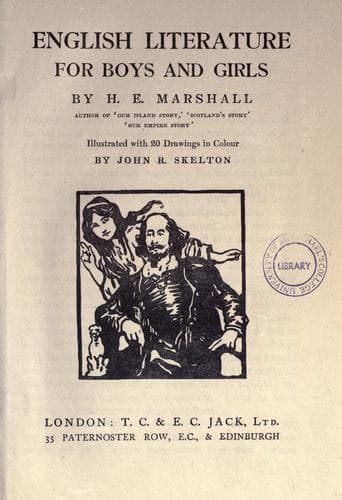
English Literature for Boys and GirlsMarshall, H. E. (Henrietta Elizabeth)
History
English Literature for Boys and Girls
Marshall, H. E. (Henrietta Elizabeth)
English literature -- History and criticism
It seems strange to us now that in an age when Spenser and
Shakespeare had show the world what the English tongue had power
to do that any man should have been able to disbelieve in its
greatness. But so it was, and Bacon translated his books into
Latin so that they might live when English books "were not."
I will not weary you with a list of all the books Bacon wrote.
Although it is not considered his greatest work, that by which
most people know him is his Book of Essays. By an essay, Bacon
meant a testing or proving. In the short chapters of his essays
he tries and proves many things such as Friendship, Study, Honor;
and when you come to read these essays you will be surprised to
find how many of the sentences are known to you already. They
have become "household words," and without knowing it we repeat
Bacon's wisdom. But we miss in them something of human
kindliness. Bacon's wisdom is cool, calm, and calculating, and
we long sometimes for a little warmth, a little passion, and not
so much "use."
The essays are best known, but the New Atlantis is the book that
you will best like to read, for it is something of a story, and
of it I will tell you a little in the next chapter.
Chapter LIII BACON--THE HAPPY ISLAND
ATLANTIS was a fabled island of the Greeks which lay somewhere in
the Western Sea. That island, it was pretended, sank beneath the
waves and was lost, and Bacon makes believe that he finds another
island something like it in the Pacific Ocean and calls it the
New Atlantis. Here, as in More's Utopia, the people living under
just and wise laws, are happy and good. Perhaps some day you
will be interested enough to read these two books together and
compare them. Then one great difference will strike you at once.
In the Utopia all is dull and gray, only children are pleased
with jewels, only prisoners are loaded with golden chains. In
the New Atlantis jewels and gold gleam and flash, the love of
splendor and color shows itself almost in every page.
Bacon wastes no time in explanation but launches right into the
middle of his story. "We sailed from Peru," he says, "(where we
had continued by the space of one whole year) for China and
Japan, by the South Sea, taking with us victuals for twelve
months." And through all the story we are not told who the "we"
were or what their names or business. There were, we learn,
fifty-one persons in all on board the ship. After some month's
good sailing they met with storms of wind. They were driven
about now here, now there. Their food began to fail, and finding
themselves in the midst of the greatest wilderness of waters in
the world, they gave themselves us as lost. But presently one
evening they saw upon one hand what seemed like darker clouds,
but which in the end proved to be land.
"And after an hour and a half's sailing, we entered into a good
haven, being the port of a fair city, not great indeed, but well
built, and that gave a pleasant view from the sea.
Public-domain text, read in full here on John Shaqi.
Reviews
Reviews
No reviews yet
Be the first to share your thoughts on this work.
Elsewhere in the archive
Join the Discussion
Join the discussion
Sign in to leave a comment or review.
Sign InorCreate an account