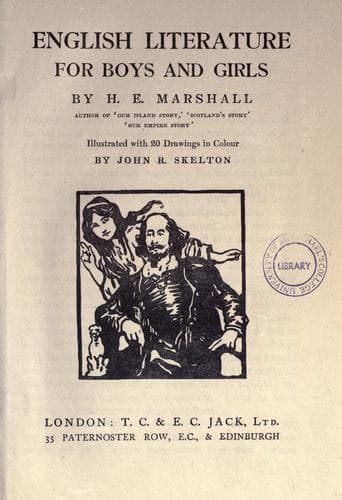
English Literature for Boys and GirlsMarshall, H. E. (Henrietta Elizabeth)
History
English Literature for Boys and Girls
Marshall, H. E. (Henrietta Elizabeth)
English literature -- History and criticism
He was not soured or bitter. "Though his fortunes may have
changed," says one of his household,* "yet I never saw any change
in his mien, his words, or his deeds, towards any man. But he
was always the same both in sorrow and joy, as a philosopher
ought to be."
*Peter Boerner, his apothecary and secretary.
Bacon was now shut out from honorable work in the world, but he
had no desire to be idle. "I have read in books," he wrote,
"that it is accounted a great bliss to have Leisure with Honour.
That was never my fortune. For time was I had Honour without
Leisure; and now I have Leisure without Honour. But my desire is
now to have Leisure without Loitering." So now he lived as he
himself said "a long cleansing week of five years." Then the end
came.
It was Bacon's thirst for knowledge that caused his death. One
winter day when the snow lay on the ground he drove out in his
coach. Suddenly as he drove along looking at the white-covered
fields and roads around, the thought came to him that food might
be kept good by means of snow as easily as by salt. He resolved
to try, so, stopping his coach, he went into a poor woman's
cottage and bought a hen. The woman killed and made ready the
hen, but Bacon was so eager about his experiment that he stuffed
it himself with snow. In doing this he was so chilled by the
cold that he became suddenly ill, too ill to return home. He was
taken to a house near "where they put him into a good bed warmed
with a pan"* and there after a few days he died.
*J. Aubrey.
This little story of how Bacon came by his death gives a good
idea of how he tried to make use of his philosophy. He was not
content with thinking and speculating, that is, looking at ideas.
Speculate comes from the Latin speculari, to spy out. He wanted
to experiment too. And although in those days no one had thought
about it, we now know that Bacon was quite right and that meat
can be kept by freezing it. And it is pleasant to know that
before Bacon died he was able to write that the experiment had
succeeded "excellently well."
In his will Bacon left his name and memory "to men's charitable
speeches, to foreign nations and to the next ages," and he was
right to do so, for in spite of all the dark shadows that hang
about his name men still call him great. We remember him as a
great man among great men; we remember him as the fore-runner of
modern science; we remember him for the splendid English in which
he wrote.
And yet, although Bacon's English is clear, strong, and fine,
although Elizabethan English perhaps reached in him its highest
point, he himself despised English. He did not believe that it
was a language that would live. And as he wanted his books to be
read by people all over the world and in all time to come, he
wrote his greatest books in Latin. He grieved that he had wasted
time in writing English, and he had much that he wrote in English
translated into Latin during his lifetime.
Public-domain text, read in full here on John Shaqi.
Reviews
Reviews
No reviews yet
Be the first to share your thoughts on this work.
Elsewhere in the archive
Join the Discussion
Join the discussion
Sign in to leave a comment or review.
Sign InorCreate an account