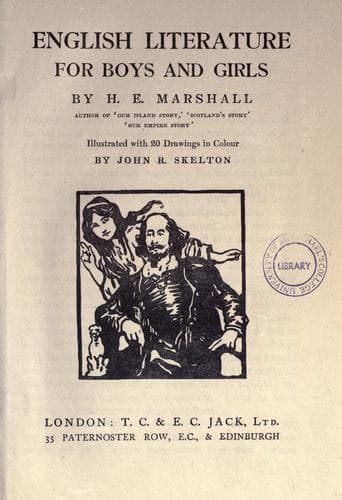
English Literature for Boys and GirlsMarshall, H. E. (Henrietta Elizabeth)
History
English Literature for Boys and Girls
Marshall, H. E. (Henrietta Elizabeth)
English literature -- History and criticism
Soon after this, George Herbert was offered the living of
Bemerton near Salisbury. But although he had already made up his
mind to become a priest he was as yet only a deacon. This sudden
offer made him fearful. He began again to question himself and
wonder if he was good enough for such a high calling. For a
month he fasted and prayed over it. But in the end Laud, Bishop
of London, assured him "that the refusal of it was a sin." So
Herbert put off his sword and gay silken clothes, and putting on
the long dark robe of a priest turned his back for ever to
thoughts of a court life. "I now look back upon my aspiring
thoughts," he said, "and think myself more happy than if I had
attained what I so ambitiously thirsted for. I can now behold
the court with an impartial eye, and see plainly that it is made
up of fraud and titles and flattery, and many other such empty,
imaginary, painted pleasures." And having turned his back on all
gayety, he began the life which earned for him the name of
"saintly George Herbert." He taught his people, preached to
them, and prayed with them so lovingly that they loved him in
return. "Some of the meaner sort of his parish did so love and
reverence Mr. Herbert that they would let their plough rest when
Mr. Herbert's saint's bell rang to prayers, that they might also
offer their devotions to God with him; and would then return back
to their plough. And his most holy life was such, that it begot
such reverence to God and to him, that they thought themselves
the happier when they carried Mr. Herbert's blessing back with
them to their labour."*
*Walton.
But he did not only preach, he practised too. I must tell you
just one story to show you how he practiced. Herbert was very
fond of music; he sang, and played too, upon the lute and viol.
One day as he was walking into Salisbury to play with some
friends "he saw a poor man with a poorer horse, which was fallen
under his load. They were both in distress and needed present
help. This Mr. Herbert perceiving put off his canonical coat,
and helped the poor man to unload, and after to load his horse.
The poor man blest him for it, and he blest the poor man, and was
so like the Good Samaritan that he gave him money to refresh both
himself and his horse, and told him, that if he loved himself, he
should be merciful to his beast. Thus he left the poor man.
Public-domain text, read in full here on John Shaqi.
Reviews
Reviews
No reviews yet
Be the first to share your thoughts on this work.
Elsewhere in the archive
Join the Discussion
Join the discussion
Sign in to leave a comment or review.
Sign InorCreate an account