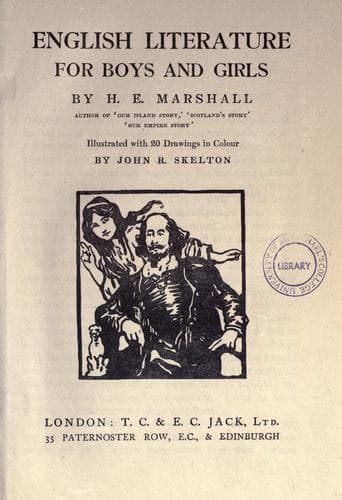
English Literature for Boys and GirlsMarshall, H. E. (Henrietta Elizabeth)
History
English Literature for Boys and Girls
Marshall, H. E. (Henrietta Elizabeth)
English literature -- History and criticism
"And at his coming to his musical friends at Salisbury, they
began to wonder that Mr. George Herbert, which used to be so trim
and clean, came into that company so soiled and discomposed. But
he told them the occasion. And when one of the company told him,
he had disparaged himself by so dirty an employment, his answer
was: that the thought of what he had done would prove music to
him at midnight, and the omission of it would have upbraided and
made discord in his conscience whensoever he should pass by that
place. 'For if I be bound to pray for all that be in distress, I
am sure that I am bound, so far as it is in my power, to practice
what I pray for. And though I do not wish for the like occasion
every day, yet let me tell you, I would not willingly pass one
day of my life without comforting a sad soul or shewing mercy.
And I praise God for this occasion.
"'And now let's tune our instruments.'"*
*Walton.
This story reminds us that besides being a parson Herbert was a
courtier and a fine gentleman. His courtly friends were
surprised that he should lower himself by helping a poor man with
his own hands. But that is just one thing that we have to
remember about Herbert, he had nothing of the puritan in him, he
was a cavalier, a courtier, yet he showed the world that it was
possible to be these and still be a good man. He did not believe
that any honest work was a "dirty employment." In one of his
poems he says:
"Teach me my God and King,
In all things Thee to see,
And what I do in anything
To do it as for Thee.
. . . . .
"All may of Thee Partake:
Nothing can be so mean
Which with his tincture (for Thy sake)
Will not grow bright and clean.
"A Servant with this clause
Makes drudgery divine;
Who sweeps a room as for Thy laws
Makes that and th' action fine.
"This is the famous stone
That turneth all to gold;
For that which God doth touch and own
Cannot for less be told."*
*Counted.
I have told you the story about Herbert and the poor man in the
words of Izaak Walton, the first writer of a life of George
Herbert. I hope some day you will read that life and also the
other books Walton wrote, for although we have not room for him
in this book, his books are one of the delights of our literature
which await you.
In all Herbert's work among his people, his wife was his
companion and help, and the people loved her as much as they
loved their parson. "Love followed her," says Walton, "in all
places as inseparably as shadows follow substances in sunshine."
Besides living thus for his people Herbert almost rebuilt the
church and rectory both of which he found very ruined. And when
he had made an end of rebuilding he carved these words upon the
chimney in the hall of the Rectory:
Public-domain text, read in full here on John Shaqi.
Reviews
Reviews
No reviews yet
Be the first to share your thoughts on this work.
Elsewhere in the archive
Join the Discussion
Join the discussion
Sign in to leave a comment or review.
Sign InorCreate an account