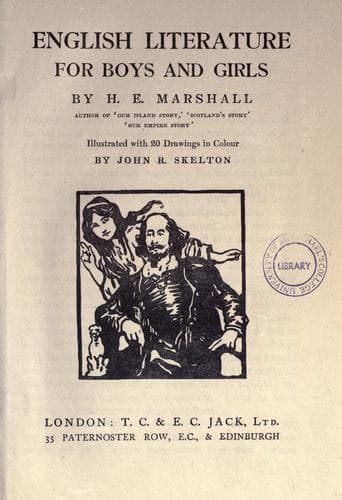
English Literature for Boys and GirlsMarshall, H. E. (Henrietta Elizabeth)
History
English Literature for Boys and Girls
Marshall, H. E. (Henrietta Elizabeth)
English literature -- History and criticism
When, on a bleak December day in 1606, more than three hundred
years ago, Milton was born, Elizabeth was dead, and James of
Scotland sat upon the throne, but many of the great Elizabethans
still lived. Shakespeare was still writing, still acting,
although he had become a man of wealth and importance and the
owner of New Place. Ben Jonson was at the very height of his
fame, the favorite alike of Court and Commons. Bacon was just
rising to power and greatness, his Novum Organum still to come.
Raleigh, in prison, was eating his heart out in the desire for
freedom, trying to while away the dreary hours with chemical
experiments, his great history not yet begun. Of the crowd of
lyric writers some were boys at college, some but children in the
nursery, and some still unborn. Yet in spite of the many writers
who lived at or about the same time, Milton stands alone in our
literature.
John Milton was the son of a London scrivener, that is, a kind of
lawyer. He was well-to-do and a Puritan. Milton's home,
however, must have been brighter than many a Puritan home, for
his father loved music, and not only played well, but also
composed. He taught his son to play too, and all through his
life Milton loved music.
John was a pretty little boy with long golden brown hair, a fair
face and dark gray eyes. But to many a strict Puritan, beauty
was an abomination, and we are told that one of Milton's
schoolmasters "was a Puritan in Essex who cut his hair short."
No doubt to him a boy with long hair was unseemly. John was the
eldest and much beloved son of his father, who perhaps petted and
spoiled him. He was clever as well as pretty, and already at the
age of ten he was looked upon by his family as a poet. He was
very studious, for besides going to St. Paul's School he had a
private tutor. Even with that he was not satisfied, but studied
alone far into the night. "When he went to schoole, when he was
very young," we are told, "he studied hard and sate up very late:
commonly till twelve or one at night. And his father ordered the
mayde to sitt up for him. And in those years he composed many
copies of verses, which might well become a riper age."* We can
imagine to ourselves the silence of the house, when all the
Puritan household had been long abed. We can picture the warm
quiet room where sits the little fair-haired boy poring over his
books by the light of flickering candles, while in the shadow a
stern-faced white-capped Puritan woman waits. She sits very
straight in her chair, her worn hands are folded, her eyes heavy
with sleep. Sometimes she nods. Then with a start she shakes
herself wide awake again, murmuring softly that it is no hour for
any Christian body to be out o' bed, wondering that her master
should allow so young a child to keep so long over his books.
Still she has her orders, so with a patient sigh she folds her
hands again and waits. Thus early did Milton begin to shape his
Public-domain text, read in full here on John Shaqi.
Reviews
Reviews
No reviews yet
Be the first to share your thoughts on this work.
Elsewhere in the archive
Join the Discussion
Join the discussion
Sign in to leave a comment or review.
Sign InorCreate an account