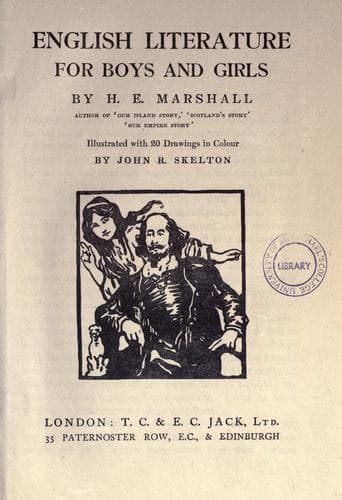
English Literature for Boys and GirlsMarshall, H. E. (Henrietta Elizabeth)
History
English Literature for Boys and Girls
Marshall, H. E. (Henrietta Elizabeth)
English literature -- History and criticism
own course and to live a life apart from others.
*Aubrey.
At sixteen Milton went to Christ's College, Cambridge. And here
he earned for himself the name of the Lady of Christ's, both
because of his beautiful face and slender figure, and because he
stood haughtily aloof from amusements which seemed to him coarse
or bad. In going to Cambridge, Milton had meant to study for the
Church. But all through life he stood for liberty. "He thought
that man was made only for rebellion," said a later writer.* As
a child he had gone his own way, and as he grew older he found it
harder and harder to agree with all that the Church taught--"till
coming to some maturity of years, and perceiving what tyranny had
invaded in the Church, that he who would take orders must
subscribe slaves, and take an oath withal. . . . I thought it
better to prefer a blameless silence before the sacred office of
speaking, bought and begun with servitude and forswearing." Thus
was he, he says, "church-outed by the Prelates."* Milton could
not, with a free conscience, become a clergyman, so having taken
his degree he went home to his father, who now lived in the
country at Horton. He left Cambridge without regrets. No thrill
of pleasure seemed to have warmed his heart in after days when he
looked back upon the young years spent beside the Cam.
*The Reason of Church Government, book II.
Milton went home to his father's house without any settled plan
of life. He had not made up his mind what he was to be, he was
only sure that he could not be a clergyman. His father was well
off, but not wealthy. He had no great estates to manage, and he
must have wished his eldest son to do and be something in the
world, yet he did not urge it upon him. Milton himself, however,
was not quite at rest, as his sonnet On his being arrived to the
age of twenty-three shows:--
"How soon hath Time, the subtle thief of youth,
Stolen on his wing my three-and-twentieth year:
My hasting days fly on with full career,
But my late Spring no bud or blossom show'th.
Perhaps my semblance might deceive the truth,
That I to manhood am arriv'd so near,
And inward ripeness doth much less appear,
That some more timely happy spirits endu'th.
Yet be it less or more, or soon or slow,
It shall be still in strictest measure even
To that same lot, however mean, or high,
Toward which Time leads me; and the Will of Heaven;
All is, if I have grace to use it so,
As ever in my great Task-Master's eye."
Public-domain text, read in full here on John Shaqi.
Reviews
Reviews
No reviews yet
Be the first to share your thoughts on this work.
Elsewhere in the archive
Join the Discussion
Join the discussion
Sign in to leave a comment or review.
Sign InorCreate an account