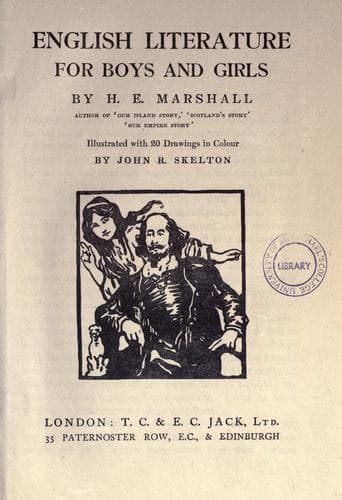
English Literature for Boys and GirlsMarshall, H. E. (Henrietta Elizabeth)
History
English Literature for Boys and Girls
Marshall, H. E. (Henrietta Elizabeth)
English literature -- History and criticism
"But let my due feet never fail
To walk the studious cloisters pale;
And love the high embowéd roof,
With antique pillars massy proof,
And storied windows richly dight,
Casting a dim religious light.
There let the pealing organ blow
To the full-voic'd choir below,
In service high, and anthem clear,
As may with sweetness through mine ear,
Dissolve me into ecstacies,
And bring all Heaven before mine eyes."
In Lycidas Milton mourns the death of a friend who was drowned
while crossing the Irish Channel. He took the name from an
Italian poem, which told of the sad death of another Lycidas.
The verse moves with even more stately measure than Il Penseroso.
"Bitter constraint, and sad occasion dear,
Compels me to disturb your season due:
For Lycidas is dead, dead ere his prime,
Young Lycidas, and hath not left his peer:
Who would not sing for Lycidas? he knew
Himself to sing, and build the lofty rhyme.
. . . . . .
Fame is the spur that the clear spirit doth raise,
(That last infirmity of noble minds)
To scorn delights, and live laborious days;
But the fair guerdon when we hope to find,
And think to burst out into sudden blaze,
Comes the blind Fury with th' abhorréd shears,
And slits the thin-spun life."
It was during these early years spent at Horton, too, that Milton
wrote his masque of Comus. It is strange to find a Puritan poet
writing a masque, for Puritans looked darkly on all acting. It
is strange to find that, in spite of the Puritan dislike to
acting, the last and, perhaps, the best masque in our language
should be written by a Puritan, and that not ten years before all
the theaters in the land were closed by Puritan orders. But
although, in many ways, Milton was sternly Puritan, these were
only the better ways. He had no hatred of beauty, "God has
instilled into me a vehement love of the beautiful," he says.
The masque of Comus was written for a great entertainment given
by the Earl of Bridgewater, at Ludlow Castle, and three of his
children took part in it. In a darksome wood, so the story runs,
the enchanter, Comus, lived with his rabble rout, half brute,
half man. For to all who passed through the wood Comus offered a
glass from which, if any drank, --
"Their human countenance,
Th' express resemblance of the gods, is changed
Into some brutish form of wolf, or bear,
Or ounce, or tiger, hog, or bearded goat,
All other parts remaining as they were."
And they, forgetting their home and friends, henceforth live
riotously with Comus.
Public-domain text, read in full here on John Shaqi.
Reviews
Reviews
No reviews yet
Be the first to share your thoughts on this work.
Elsewhere in the archive
Join the Discussion
Join the discussion
Sign in to leave a comment or review.
Sign InorCreate an account