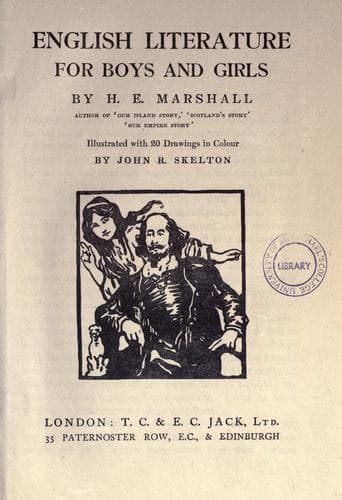
English Literature for Boys and GirlsMarshall, H. E. (Henrietta Elizabeth)
History
English Literature for Boys and Girls
Marshall, H. E. (Henrietta Elizabeth)
English literature -- History and criticism
Yet dissatisfied as he sometimes was, he was very sure of
himself, and for five years he let his wings grow, as he himself
said. But these years were not altogether lost, for if both day
and night Milton roamed the meadows about his home in seeming
idleness, he was drinking in all the beauty of earth and sky,
flower and field, storing his memory with sights and sounds that
were to be a treasure to him in after days. He studied hard,
too, ranging at will through Greek and Latin literature. "No
delay, no rest, no care or thought almost of anything holds me
aside until I reach the end I am making for, and round off, as it
were, some great period of my studies," he says to a friend. And
as the outcome of these five fallow years Milton has left us some
of his most beautiful poems. They have not the stately grandeur
of his later works, but they are natural and easy, and at times
full of a joyousness which we never find in him again. And
before we can admire his great poem which he wrote later, we may
love the beauty of L'Allegro, Il Penseroso, and Lycidas, which he
wrote now.
L'Allegro and Il Penseroso are two poems which picture two moods
in which the poet looks at life. They are two moods which come
to every one, the mirthful and the sad. L'Allegro pictures the
happy mood. Here the man "who has, in his heart, cause for
contentment" sings. And the poem fairly dances with delight of
being as it follows the day from dawn till evening shadows fall.
It begins by bidding "loathed Melancholy" begone "'Mongst horrid
shapes, and shrieks, and sights unholy," and by bidding come
"heart-easing Mirth."
"Haste, thee, nymph, and bring with thee
Jest and youthful Jollity,
Quips and cranks, and wanton wiles,
Nods and becks, and wretchéd smiles.
Such as hang on Hebe's cheek,
And love to live in dimple sleek;
Sport that wrinkled Care derides,
And Laughter holding both his sides.
Come, and trip it as ye go
On the light fantastic toe.
. . . . .
To hear the lark begin his flight,
And singing startle the dull night,
From his watch-tower in the skies,
Till the dappled dawn doth rise."
These are a few lines from the opening of the poem which you must
read for yourselves, for if I quoted all that is beautiful in it
I should quote the whole.
Il Penseroso pictures the thoughtful mood, or mood of gentle
Melancholy. Here Mirth is banished, "Hence fair deluding joys,
the brood of Folly, and hail divinest Melancholy." The poem
moves with more stately measure, "with even step, and musing
gait," from evening through the moonlit night till morn. It ends
with the poet's desire to live a peaceful studious life.
Public-domain text, read in full here on John Shaqi.
Reviews
Reviews
No reviews yet
Be the first to share your thoughts on this work.
Elsewhere in the archive
Join the Discussion
Join the discussion
Sign in to leave a comment or review.
Sign InorCreate an account