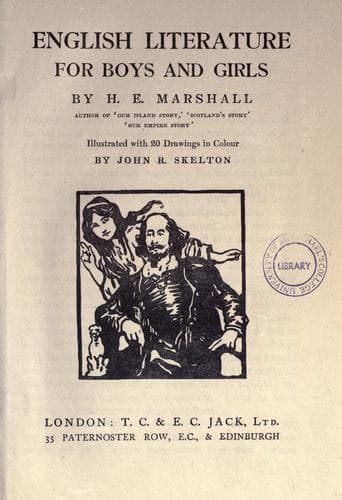
English Literature for Boys and GirlsMarshall, H. E. (Henrietta Elizabeth)
History
English Literature for Boys and Girls
Marshall, H. E. (Henrietta Elizabeth)
English literature -- History and criticism
The poor little runaway wife, we may believe, was afraid to face
her angry husband. But helped both by his friends and her own a
meeting was arranged. Milton had a friend to whose house he
often went, and in this house his wife was hid one day when the
poet came to pay a visit. While Milton waited for his friend he
was surprised, for when the door opened there came from the
adjoining room, not his friend, but "one whom he thought to have
never seen more." Mary his wife came to him, and sinking upon
her knees before him begged to be forgiven. Long after, in his
great poem, Milton seems to describe the scene when he makes Adam
cry out to Eve after the Fall, "Out of my sight, thou serpent!
That name best befits thee."
"But Eve,
Not so repulsed, with tears that ceased not flowing,
And tresses all disordered, at his feet
Fell humble, and, embracing them, besought
His peace; and thus proceeded in her plaint:
'Forsake me not thus, Adam! Witness, Heaven,
What love sincere, and reverence in my heart
I bear thee, and unweeting have offended,
Unhappily deceived! Thy suppliant
I beg, and clasp thy knees. Bereave me not,
Whereon I live, thy gentle looks, thy aid,
Thy counsel in this uttermost distress,
My only strength and stay. Forlorn of thee,
Whither shall I betake me? where subsist?
While yet we live, scarce one short hour perhaps,
Between us two let there be peace.'
. . . . . . .
She ended weeping; and her lowly plight,
Immovable till peace obtained from fault
Acknowledged and deplored, in Adam wrought
Commiseration. Soon his heart relented
Towards her, his life so late and sole delight,
Now at his feet submissive in distress,
Creature so fair his reconcilement seeking,
His counsel, whom she had displeased, his aid;
As one disarmed, his anger all he lost,
And thus with peaceful words upraised her soon."
Milton thus took back to his home his wandering wife and not her
only, but also her father, mother, and homeless brothers and
sisters. So although he had moved to a larger house, it was now
full to overflowing, for besides all this Royalist family he had
living with him his pupils and his own old father.
Chapter LVIII MILTON--DARKNESS AND DEATH
AND now for twenty years the pen of Milton was used, not for
poetry, but for prose. The poet became a politician. Victory
was still uncertain, and Milton poured out book after book in
support of the Puritan cause. These books are full of wrath and
scorn and all the bitter passion of the time. They have hardly a
place in true literature, so we may pass them over glad that
Milton found it possible to spend his bitterness in prose and
leave his poetry what it is.
Public-domain text, read in full here on John Shaqi.
Reviews
Reviews
No reviews yet
Be the first to share your thoughts on this work.
Elsewhere in the archive
Join the Discussion
Join the discussion
Sign in to leave a comment or review.
Sign InorCreate an account