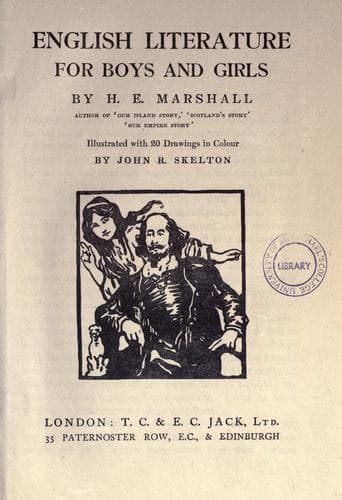
English Literature for Boys and GirlsMarshall, H. E. (Henrietta Elizabeth)
History
English Literature for Boys and Girls
Marshall, H. E. (Henrietta Elizabeth)
English literature -- History and criticism
One only of his prose works is still remembered and still read
for its splendid English. That is Areopagitica, a passionate
appeal for a free press. Milton desired that a man should have
not only freedom of thought, but freedom to write down and print
and publish these thoughts. But the rulers of England, ever
since printing had been introduced, had thought otherwise, and by
law no book could be printed until it had been licensed, and no
man might set up a printing press without permission from
Government. To Milton this was tyranny. "As good almost kill a
man as kill a good book," he said, and again "Give me the liberty
to know, to utter, and to argue freely according to my conscience
above all liberties." He held the licensing law in contempt, and
to show his contempt he published Areopagitica without a license
and without giving the printer's or bookseller's name. It was
not the first time Milton had done this, and his enemies tried to
use it against him to bring him into trouble. But he had become
by this time too important a man, and nothing came of it.
Time went on, the bitter struggle between King and people came to
an end. The people triumphed, and the King laid his head upon
the block. Britain was without ruler other than Parliament. It
was then, one March day in 1649, that a few grave-faced, somber-
clad men knocked at the door of Milton's house. We can imagine
them tramping into the poet's low-roofed study, their heavy shoes
resounding on the bare floor, their sad faces shaded with their
tall black hats. And there, in sing-song voices, they tell the
astonished man that they come from Parliament to ask him to be
Secretary for Foreign Tongues.
Milton was astonished, but he accepted the post. And now his
life became a very busy one. It had been decided that all
letters to foreign powers should be written in Latin, but many
Governments wrote to England in their own languages. Milton had
to translate these letters, answer them in Latin, and also write
little books or pamphlets in answer to those which were written
against the Government.
It was while he was busy with this, while he was pouring out
bitter abuse upon his enemies or upon the enemies of his party,
that his great misfortune fell upon him. He became blind. He
had had many warnings. He had been told to be careful of his
eyes, for the sight of one had long been gone. But in spite of
all warnings he still worked on, and at length became quite
blind.
His enemies jeered at him, and said it was a judgment upon him
for his wicked writing. But never for a moment did Milton's
spirit quail. He had always been sure of himself, sure of his
mission in life, sufficient for himself. And now that the horror
of darkness shut him off from others, shut him still more into
himself, his heart did not fail him. Blind at forty-three, he
wrote:--
Public-domain text, read in full here on John Shaqi.
Reviews
Reviews
No reviews yet
Be the first to share your thoughts on this work.
Elsewhere in the archive
Join the Discussion
Join the discussion
Sign in to leave a comment or review.
Sign InorCreate an account