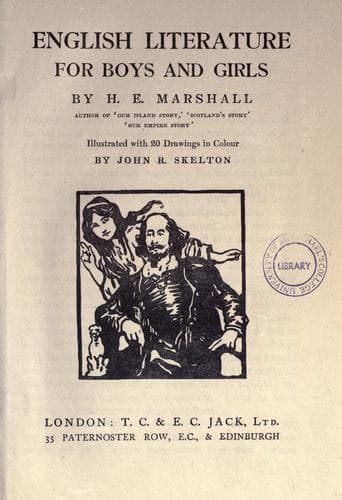
English Literature for Boys and GirlsMarshall, H. E. (Henrietta Elizabeth)
History
English Literature for Boys and Girls
Marshall, H. E. (Henrietta Elizabeth)
English literature -- History and criticism
Thus Bunyan's long imprisonment of twelve years began. He had
married again by this time, and the parting with his wife and
children was hard for him, and harder still for the young wife
left behind "all smayed at the news." But although she was
dismayed she was brave of heart, and she at once set about
eagerly doing all she could to free her husband. She went to
London, she ventured into the House of Lords, and there pleaded
for him. Touched by her earnestness and her helplessness the
Lords treated her kindly. But they told her they could do
nothing for her and that she must plead her case before the
ordinary judges.
So back to Bedford she went, and with beating heart and trembling
limbs sought out the judges. Again she was kindly received, but
again her petition was of no avail. The law was the law. Bunyan
had broken the law and must suffer. He would not promise to
cease from preaching, she would as little promise for him. "My
lord," she said, "he dares not leave off preaching as long as he
can speak."
So it was all useless labor, neither side could or would give way
one inch. Bursting into tears the poor young wife turned away.
But she wept "not so much because they were so hard-hearted
against me and my husband, but to think what a sad account such
poor creatures will have to give at the coming of the Lord, when
they shall then answer for all things whatsoever they have done
in the body, whether it be good, or whether it be bad."
Seeing there was no help for it, Bunyan set himself bravely to
endure his imprisonment. And, in truth, this was not very
severe. Strangely enough he was allowed to preach to his fellow-
prisoners, he was even at one time allowed to go to church. But
the great thing for us is that he wrote books. Already, before
his imprisonment, he had written several books, and now he wrote
that for which he is most famous, the Pilgrim's Progress.
It is a book so well known and so well loved that I think I need
say little about it. In the form of a dream Bunyan tells, as you
know, the story of Christian who set out on his long and
difficult pilgrimage from the City of Destruction to the City of
the Blest. He tells of all Christian's trials and adventures on
the way, of how he encounters giants and lion, of how he fights
with a great demon, and of how at length he arrives at his
journey's end in safety. A great writer has said, "There is no
book in our literature on which we would so readily stake the
fame of the old unpolluted English language, no book which shows
so well how rich that language is in its own proper wealth, and
how little it has been improved by all that it has borrowed."*
*Macaulay.
Public-domain text, read in full here on John Shaqi.
Reviews
Reviews
No reviews yet
Be the first to share your thoughts on this work.
Elsewhere in the archive
Join the Discussion
Join the discussion
Sign in to leave a comment or review.
Sign InorCreate an account