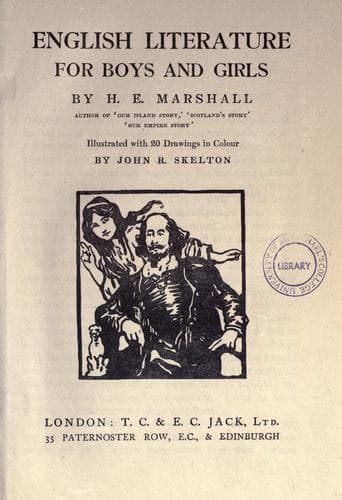
English Literature for Boys and GirlsMarshall, H. E. (Henrietta Elizabeth)
History
English Literature for Boys and Girls
Marshall, H. E. (Henrietta Elizabeth)
English literature -- History and criticism
Bunyan himself tells us the story of this long fight in a book
called Grace Abounding to the Chief of Sinners. As we read we
cannot help but see that Bunyan was never a very wicked man, but
merely a man with a very tender conscience. Things which seemed
to other men trifles were to him deadly sins; and although he was
so stern to himself, to others he shows a fatherly tenderness
which makes us feel that this rough tinker was no narrow Puritan,
but a broad-minded, large-hearted Christian. And now that Bunyan
had found peace he became a Baptist, and joined the church of a
man whom he calls "the holy Mr. Gifford." Gifford had been an
officer in the Royal army. He had been wild and drunken, but
repenting of his evil ways had become a preacher. Now, until he
died some years later, he was Bunyan's fast friend.
In the same year as Bunyan lost his friend his wife too died, and
he was left alone with four children, two of them little girls,
one of whom was blind. She was, because of that, all the more
dear to him. "She lay nearer to my heart than all beside," he
says.
And now Bunyan's friends found out his great gift of speech.
They begged him to preach, but he was so humble and modest that
at first he refused. At length, however, he was over-persuaded.
He began his career as a minister and soon became famous. People
came from long distances to hear him, and he preached not only in
Elstow and Bedford but in all the country round. He preached,
not only in churches, but in barns and in fields, by the roadside
or in the market-place, anywhere, in fact, where he could gather
an audience.
It was while Cromwell ruled that Bunyan began this ministry. But
in spite of all the battles that had been fought for religious
freedom, there was as yet no real religious freedom in England.
Each part, as it became powerful, tried to tyrannize over every
other party, and no one was allowed to preach without a license.
The Presbyterians were now in power; Bunyan was a Baptist, and
some of the Presbyterians would gladly have silenced him. Yet
during Cromwell's lifetime he went his way in peace. Then the
Restoration came. A few months later Bunyan was arrested for
preaching without a license. Those who now ruled "were angry
with the tinker because he strove to mend souls as well as
kettles and pans."* Before he was taken prisoner Bunyan was
warned of his danger, and if he had "been minded to have played
the coward" he might have escaped. But he would not try to save
himself. "If I should now run to make an escape," he said, "it
will be a very ill savour in the country. For what will my weak
and newly-converted brethren think of it but that I was not so
strong in deed as I was in word."
*Henry Deane.
So Bunyan was taken prisoner. Even then he might have been at
once set free would he have promised not to preach. But to all
persuasions he replied, "I durst not leave off that work which
God has called me to."
Public-domain text, read in full here on John Shaqi.
Reviews
Reviews
No reviews yet
Be the first to share your thoughts on this work.
Elsewhere in the archive
Join the Discussion
Join the discussion
Sign in to leave a comment or review.
Sign InorCreate an account