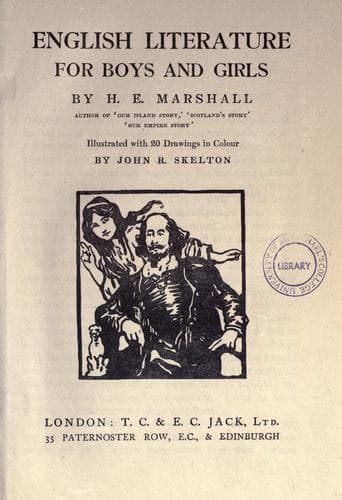
English Literature for Boys and GirlsMarshall, H. E. (Henrietta Elizabeth)
History
English Literature for Boys and Girls
Marshall, H. E. (Henrietta Elizabeth)
English literature -- History and criticism
He also wrote the Life and Death of Mr. Badman. Instead of
telling how a good man struggles with evil and at last wins rest,
it tells of how a bad man yields always to evil and comes at last
to a sad end. It is not a pretty story, and is one, I think,
which you will not care to read.
Bunyan, too, wrote a good deal of rime, but for the most part it
can hardly be called poetry. It is for his prose that we
remember him. Yet who would willingly part with the song of the
shepherd-boy in the second part of the Pilgrim's Progress:--
"He that is down needs fear no fall;
He that is low, no pride:
He that is humble, ever shall
Have God to be his guide.
I am content with what I have,
Little be it or much:
And, Lord, contentment still I crave,
Because thou savest such.
Fullness to such a burden is
That go on pilgrimage:
Here little, and hereafter bliss,
Is best from age to age."
When Bunyan had been in prison for six years he was set free, but
as he at once began to preach he was immediately seized and
reimprisoned. He remained shut up for six years longer. Then
King Charles II passed an Act called the Declaration of
Indulgence. By this Act all the severe laws against those who
did not conform to the Church of England were done away with,
and, in consequence, Bunyan was set free. Charles passed this
Act, not because he was sorry for the Nonconformists--as all who
would not conform to the Church of England were called--but
because he wished to free the Roman Catholics, and he could not
do that without freeing the Nonconformists too. Two years later
Bunyan was again imprisoned because "in contempt of his Majesty's
good laws he preached or teached in other manner than according
to the Liturgy or practice of the Church of England." But this
time his imprisonment lasted only six months. And I must tell
you that many people now think that it was during this later
short imprisonment that Bunyan wrote the Pilgrim's Progress, and
not during the earlier and longer.
The rest of Bunyan's life passed peacefully and happily. But we
know few details of it, for "he seems to have been too busy to
keep any records of his busy life."* We know at least that it
was busy. He was now a licensed preacher, and if the people had
flocked to hear him before his imprisonment they flocked in far
greater numbers now. Even learned men came to hear him. "I
marvel," said King Charles to one, "that a learned man such as
you can sit and listen to an unlearned tinker."
*Brown.
"May it please your Majesty," replied he, "I would gladly give up
all my learning if I could preach like that tinker."
Public-domain text, read in full here on John Shaqi.
Reviews
Reviews
No reviews yet
Be the first to share your thoughts on this work.
Elsewhere in the archive
Join the Discussion
Join the discussion
Sign in to leave a comment or review.
Sign InorCreate an account