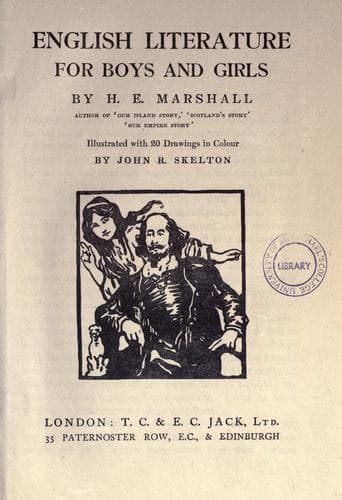
English Literature for Boys and GirlsMarshall, H. E. (Henrietta Elizabeth)
History
English Literature for Boys and Girls
Marshall, H. E. (Henrietta Elizabeth)
English literature -- History and criticism
Bunyan became the head of the Baptist Church. Near and far he
traveled, preaching and teaching, honored and beloved wherever he
went. And his word had such power, his commands had such weight,
that people playfully called him Bishop Bunyan. Yet he was "not
puffed up in prosperity, nor shaken in adversity, always holding
the golden mean."*
*Charles Doe.
Death found Bunyan still busy, still kindly. A young man who
lived at Reading had offended his father so greatly that the
father cast him off. In his trouble the young man came to
Bunyan. He at once mounted his horse and rode off to Reading.
There he saw the angry father, and persuaded him to make peace
with his repentant son.
Glad at his success, Bunyan rode on to London, where he meant to
preach. But the weather was bad, the roads were heavy with mud,
he was overtaken by a storm of rain, and ere he could find
shelter he was soaked to the skin. He arrived at length at a
friend's house wet and weary and shaking with fever. He went to
bed never to rise again. The time had come when, like Christian,
he must cross the river which all must cross "where there is no
bridge to go over and the river very deep." But Bunyan, like
Christian, was held up by Hope. He well knew the words, "When
thou passest through the waters I will be with thee, and through
the rivers they shall not overflow thee." And so he crossed
over.
And may we not believe that Bunyan, when he reached the other
side, heard again, as he had once before heard in his immortal
dream, "all the bells in the city ring again with joy," and that
it was said unto him, "Enter ye into the joy of our Lord"?
YEAR 9
Chapter LX DRYDEN--THE NEW POETRY
"THE life of Dryden may be said to comprehend a history of the
literature of England, and its changes, during nearly half a
century." With these words Sir Walter Scott, himself a great
writer, began his life of John Dryden. Yet although Dryden
stands for so much in the story of our literature, as a man we
know little of him. As a writer his influence on the age in
which he lived was tremendous. As a man he is more shadowy than
almost any other greater writer. We seem to know Chaucer, and
Spenser, and Milton, and even Shakespeare a little, but to know
Dryden in himself seems impossible. We can only know him through
his works, and through his age. And in him we find the
expression of his age.
With Milton ended the great romantic school of poetry. He was
indeed as one born out of time, a lonely giant. He died and left
no follower. With Dryden began a new school of poetry, which was
to be the type of English poetry for a hundred and fifty years to
come. This is called the classical school, and the rime which
the classical poets used is called the heroic couplet. It is a
long ten-syllabled line, and rimes in couplets, as, for
instance:--
Public-domain text, read in full here on John Shaqi.
Reviews
Reviews
No reviews yet
Be the first to share your thoughts on this work.
Elsewhere in the archive
Join the Discussion
Join the discussion
Sign in to leave a comment or review.
Sign InorCreate an account