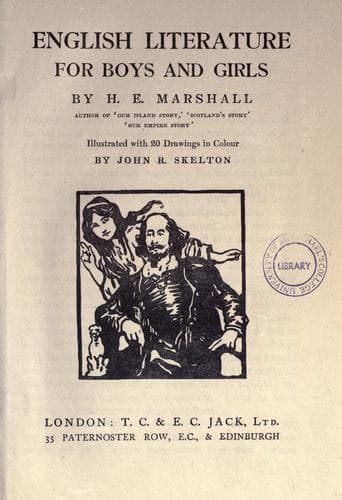
English Literature for Boys and GirlsMarshall, H. E. (Henrietta Elizabeth)
History
English Literature for Boys and Girls
Marshall, H. E. (Henrietta Elizabeth)
English literature -- History and criticism
If you can see the difference between these two quotations you
can see the difference between the poetry of Dryden's age and all
that went before him. It is the difference between art and
nature. Chaucer sings like a bird, Dryden like a trained concert
singer who knows that people are listening to him. There is room
for both in life. We want and need both.
If you can feel the difference between Chaucer and Dryden you
will understand in part what I meant by saying that Dryden was
the expression of his time. For in Restoration times the taste
was for art rather than for natural beauty. The taste was for
what was clever, witty, and polished rather than for the simple,
stately grandeur of what was real and true. Poetry was utterly
changed. It no longer went to the heart but to the brain.
Dryden's poetry does not make the tears start to our eye or the
blood come to our cheek, but it flatters our ear with its
smoothness and elegance; it tickles our fancy with its wit.
You will understand still better what the feeling of the times
was when I tell you that Dryden, with the help of another poet,
re-wrote Shakespeare's Tempest and made it to suit the fashion of
the day. In doing so they utterly spoiled it. As literature it
is worthless; as helping us to understand the history of those
times it is useful. But although The Tempest, as re-written by
Dryden, is bad, one of the best of his plays is founded upon
another of Shakespeare's. This play is called All for Love or
the World Well Lost, and is founded upon Shakespeare's Antony and
Cleopatra. It is not written in Dryden's favorite heroic couplet
but in blank verse. "In my style," he says, "I have professed to
imitate the divine Shakespeare, which, that I might perform more
freely, I have disencumbered myself from rhyme. Not that I
condemn my former way, but that this is more proper to my present
purpose." And when you come to read this play you will find
that, master as Dryden was of the heroic couplet, he could write,
too, when he chose, fine blank verse.
Perhaps the best-known of all Dryden's shorter poems is the ode
called Alexander's Feast. It was written for a London musical
society, which gave a concert each year on St. Cecilia's day,
when an original ode was sung in her honor. Dryden in this ode,
which was sung in 1697, pictures Timotheus, the famous Greek
musician and poet, singing before Alexander, at a great feast
which was held after the conquest of Persia. Alexander listens
while
"The lovely Thais, by his side,
Sate like a blooming Eastern Bride,
In flower of youth and beauty's pride.
Happy, happy, happy pair!
None but the brave,
None but the brave,
None but the brave deserves the fair!"
As Timotheus sings he stirs at will his hearers' hearts to love,
to pity, or to revenge.
"Timotheus, to his breathing flute
And sounding lyre,
Could swell the soul to rage, or kindle soft desire."
Public-domain text, read in full here on John Shaqi.
Reviews
Reviews
No reviews yet
Be the first to share your thoughts on this work.
Elsewhere in the archive
Join the Discussion
Join the discussion
Sign in to leave a comment or review.
Sign InorCreate an account