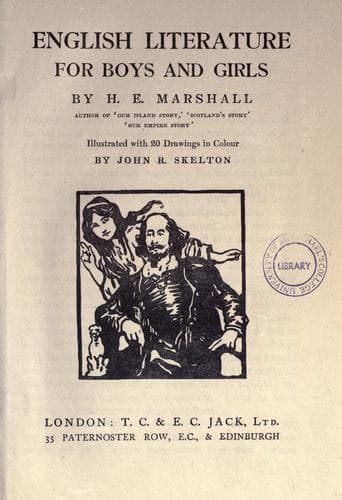
English Literature for Boys and GirlsMarshall, H. E. (Henrietta Elizabeth)
History
English Literature for Boys and Girls
Marshall, H. E. (Henrietta Elizabeth)
English literature -- History and criticism
But those were heathen times. In Christian times came St.
Cecilia and she
"Enlarged the former narrow bounds,
And added length to solemn sounds,
With nature's Mother-wit, and arts unknown before.
Let old Timotheus yield the prize.
Or both divide the crown:
He raised a mortal to the skies
She drew an angel down."
Dryden was a great poet, and he dominated his own age and the age
to come. But besides being a poet he was a great prose-writer.
His prose is clear and fine and almost modern. We do not have to
follow him through sentences so long that we lose the sense
before we come to the end. "He found English of brick and left
it marble," says a late writer, and when we read his prose we
almost believe that saying to be true. He was the first of
modern critics, that is he was able to judge the works of others
surely and well. And many of his criticisms of men were so true
that we accept them now even as they were accepted then. Here is
what he says of Chaucer in his preface to The Fables:--
"He [Chaucer] must have been a man of a most wonderful
comprehensive nature, because as it has been truly observed of
him, he has taken into the compass of his Canterbury Tales the
various manners and humours (as we now call them) of the whole
English nation, in his age. Not a single character has escaped
him. All his pilgrims are severally distinguished from each
other; and not only in their inclinations, but in their very
physiognomies persons. . . . The matter and manner of their
tales, and of their telling are so suited to their different
educations, humours, and callings, that each of them would be
improper in any other mouth. Even the grave and serious
characters are distinguished by their several sorts of gravity.
Their discourses are such as belong to their age, their calling,
and their breeding; such as are becoming to them and to them
only. Some of his persons are vicious, and some virtuous; some
are unlearned, or (as Chaucer calls them) lewd, and some are
learned. Even the ribaldry of the low characters is different:
the Reeve, the Miller, and the Cook are several men, and
distinguished from each other as much as the mincing Lady-
Prioress and the broad-speaking, gap-toothed Wife of Bath. . . .
It is sufficient to say, according to the proverb, that here is
God's plenty. We have our forefathers and great-grand-dames all
before us, as they were in Chaucer's days. Their general
characters are still remaining in mankind, and even in England,
though they are called by other names than those of monks, and
friars, and canons, and lady abbesses, and nuns; for mankind is
ever the same, and nothing lost out of nature though everything
is altered."
Public-domain text, read in full here on John Shaqi.
Reviews
Reviews
No reviews yet
Be the first to share your thoughts on this work.
Elsewhere in the archive
Join the Discussion
Join the discussion
Sign in to leave a comment or review.
Sign InorCreate an account