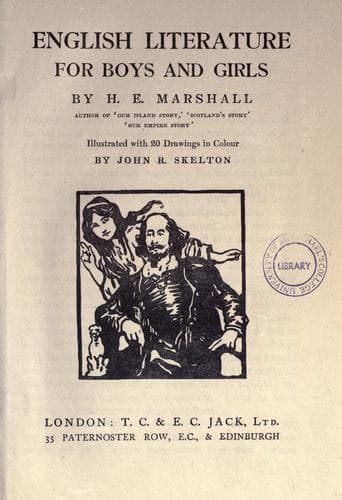
English Literature for Boys and GirlsMarshall, H. E. (Henrietta Elizabeth)
History
English Literature for Boys and Girls
Marshall, H. E. (Henrietta Elizabeth)
English literature -- History and criticism
Tell them, he stands exalted there
For speaking what we would not hear:
And yet he might have been secure,
Had he said less, or would he have said more!
Tell them the men that placed him here
Are scandals to the Times!
Are at a loss to find his guilt,
And can't commit his crimes!"
But although Defoe's friends could take the sting out of the
terrible hours during which he stood as an object for mockery
they could do little else for him. So he went back to prison to
remain there during the Queen's pleasure.
This, of course, meant ruin to him. For himself he could bear
it, but he had a wife and children, and to know that they were in
poverty and bitter want was his hardest punishment.
From prison Defoe could not manage his factory. He had to let
that go, losing with it thousands of pounds. For the second time
he saw himself ruined. But he had still left to him his pen and
his undaunted courage. So, besides writing many pamphlets in
prison, Defoe started a paper called the Review. It appeared at
first once, then twice, and at last three times a week. Unlike
our papers of to-day, which are written by many hands, Defoe
wrote the whole of the Review himself, and continued to do so for
years. It contained very little news and many articles, and when
we turn these worn and yellowing pages we find much that,
interesting in those days, has lost interest for us. But we also
find articles which, worded in clear, strong, truly English
English, seem to us as fresh and full of life as when they were
written more than two hundred years ago. We find as well much
that is of keen historical interest, and we gain some idea of the
undaunted courage of the author when we remember that the first
numbers of the Review at least were penned in a loathsome prison
where highwaymen, pirates, cut-throats, and common thieves were
his chief companions.
Chapter LXII DEFOE--"ROBINSON CRUSOE"
FOR more than a year and a half Defoe remained in prison; then he
was set free.
A new Government had come into power. It was pointed out to the
Queen that it was a mistake to make an enemy of so clever an
author as Defoe. Then he was set at liberty, but on condition
that he should use his pen to support the Government. So
although Defoe was now free to all seeming, this was really the
beginning of bondage. He was no longer free in mind, and by
degrees he became a mere hanger-on of Government, selling the
support of his pen to whichever party was in power.
We cannot follow him through all the twists and turns of his
politics, nor through all his ups and downs in life, nor mention
all the two hundred and fifty books and pamphlets that he wrote.
It was an adventurous life he led, full of dark and shadowy
passages which we cannot understand and so perhaps cannot pardon.
But whether he sold his pen or no we are bound to confess that
Defoe's desire was towards the good, towards peace, union, and
justice.
Public-domain text, read in full here on John Shaqi.
Reviews
Reviews
No reviews yet
Be the first to share your thoughts on this work.
Elsewhere in the archive
Join the Discussion
Join the discussion
Sign in to leave a comment or review.
Sign InorCreate an account