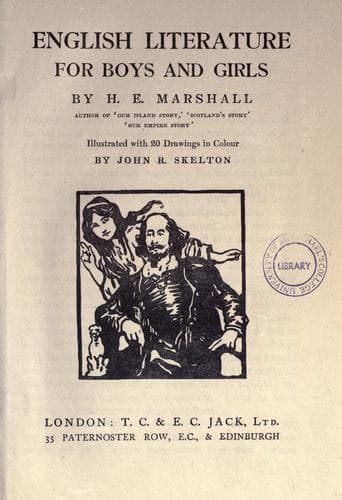
English Literature for Boys and GirlsMarshall, H. E. (Henrietta Elizabeth)
History
English Literature for Boys and Girls
Marshall, H. E. (Henrietta Elizabeth)
English literature -- History and criticism
Defoe meant this for satire. A satire is, you remember, a work
which holds up folly or wickedness to ridicule. He meant to show
the High Churchmen how absurd and wicked was their desire to
punish the Dissenters for worshiping God in their own way. He
meant to make the world laugh at them. But at first the High
Churchmen did not see that it was meant to ridicule them. They
greeted the author of this pamphlet as a friend and ally. The
Dissenters did not see the satire either, and found in the writer
a new and most bitter enemy.
But when at last Defoe's meaning became plain the High Church
party was very angry, and resolved to punish him. Defoe fled
into hiding. But a reward of fifty pounds was offered for his
discovery, and, "rather than others should be ruined by his
mistake," Defoe gave himself up.
For having written "a scandalous and seditious pamphlet" Defoe
was condemned to pay a large fine, to stand three times in the
pillory, and to be imprisoned during the Queen's pleasure. Thus
quickly did Fortune's wheel turn round. "I have seen the rough
side of the world as well as the smooth," he said long after. "I
have, in less than half a year, tasted the difference between the
closet of a King, and the dungeon of Newgate."
The pillory was a terrible punishment. In a public place, raised
on a platform, in full view of the passing crowd, the victim
stood. Round his neck was a heavy collar of wood, and in this
collar his hands were also confined. Thus he stood helpless,
unable to protect himself either from the sun or rain or from the
insults of the crowd. For a man in the pillory was a fitting
object for laughter and rude jests. To be jeered at, to have mud
thrown at him, was part of his punishment.
But for Defoe it was a triumph rather than a punishment. To the
common people he was already a hero. So they formed a guard
round him to protect him from the mud and rotten eggs his enemies
would now thrown. They themselves threw flowers, they wreathed
the pillory with roses and with laurel till it seemed a place of
honor rather than of disgrace. They sang songs in his praise and
drank to his health and wished those who had sent him there stood
in his place. Thus through all the long, hot July hours Defoe
was upheld and comforted in his disgrace. And to show that his
spirit was untouched by his sentence he wrote A Hymn to the
Pillory. This was bought and read and shouted in the ears of his
enemies by thousands of the people. It was a more daring satire
than even The Shortest Way. In the end of it Defoe calls upon
the Pillory, "Thou Bugbear of the Law," to speak and say why he
stands there:--
"Tell them, it was, because he was too bold,
And told those truths which should not have been told!
Extol the justice of the land,
Who punish what they will not understand!
Public-domain text, read in full here on John Shaqi.
Reviews
Reviews
No reviews yet
Be the first to share your thoughts on this work.
Elsewhere in the archive
Join the Discussion
Join the discussion
Sign in to leave a comment or review.
Sign InorCreate an account