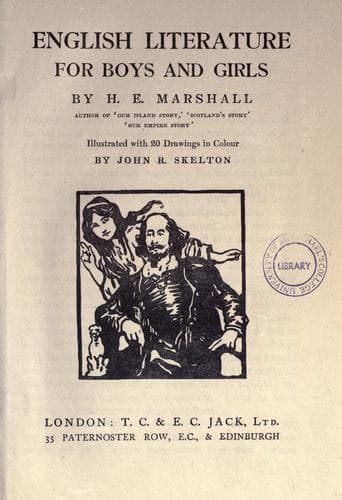
English Literature for Boys and GirlsMarshall, H. E. (Henrietta Elizabeth)
History
English Literature for Boys and Girls
Marshall, H. E. (Henrietta Elizabeth)
English literature -- History and criticism
"But this did not put a stop to the general tumult, though it
delivered this particular family. For the rabble, by this time,
were prodigiously increased, and went roving up and down the
town, breaking the windows of the Members of Parliament and
insulting them in their coaches in the streets. They put out all
the lights that they might not be discovered. And the author of
this had one great stone thrown at him for but looking out of a
window. For they suffered nobody to look out, especially with
any lights, lest they should know faces, and inform against them
afterwards.
"By this time it was about eight or nine o'clock at night, and
now they were absolute masters of the city. And it was reported
they were going to shut up all the ports.* The Lord Commissioner
being informed of that, sent a party of the foot guards, and took
possession of the Netherbow, which is a gate in the middle of the
High Street, as Temple Bar between the City of London and the
Court.
*Gates in the City Wall.
"The city was now in a terrible fright, and everybody was under
concern for their friends. The rabble went raving about the
streets till midnight, frequently beating drums, raising more
people. When my Lord Commissioner being informed, there were a
thousand of the seamen and rabble come up from Leith; and
apprehending if it were suffered to go on, it might come to a
dangerous head, and be out of his power to suppress, he sent for
the Lord Provost, and demanded that the guards should march into
the city.
"The Lord Provost, after some difficulty, yielded; though it was
alleged, that it was what never was known in Edinburgh before.
About one o'clock in the morning a battalion of the guards
entered the town, marched up to the Parliament Close, and took
post in all the avenues of the city, which prevented the
resolutions taken to insult the houses of the rest of the
treaters. The rabble were entirely reduced by this, and
gradually dispersed, and so the tumult ended."
Although Defoe did all he could to bring the Union about he felt
for and with the poor distracted people. He saw that amid the
strife of parties, proud, ignorant, mistaken, it may be, the
people were still swayed by love of country, love of freedom.
Even after the Union was accomplished Defoe remained in Scotland.
He still wrote his Review every week, and filled it so full of
Union matters that his readers began to think he could speak of
nothing else and that he was grown dull. In his Review he
wrote:--
"Nothing but Union, Union, says one now that wants diversion; I
am quite tired of it, and we hope, 'tis as good as over now.
Prithee, good Mr. Review, let's have now and then a touch of
something else to make us merry." But Defoe assures his readers
he means to go on writing about the Union until he can see some
prospect of calm among the men who are trying to make dispeace.
"Then I shall be the first that shall cease calling upon them to
Peace."
Public-domain text, read in full here on John Shaqi.
Reviews
Reviews
No reviews yet
Be the first to share your thoughts on this work.
Elsewhere in the archive
Join the Discussion
Join the discussion
Sign in to leave a comment or review.
Sign InorCreate an account