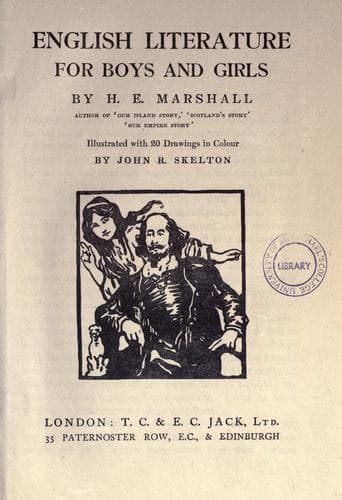
English Literature for Boys and GirlsMarshall, H. E. (Henrietta Elizabeth)
History
English Literature for Boys and Girls
Marshall, H. E. (Henrietta Elizabeth)
English literature -- History and criticism
The years went on, Defoe always living a stormy life amid the
clash of party politics, always writing, writing. More than once
his noisy, journalistic pen brought him to prison. But he was
never a prisoner long, never long silenced. Yet although Defoe
wrote so much and lived at a time when England was full of witty
writers he was outside the charmed circle of wits who pretended
not to know of his existence. "One of these authors," says
another writer, "(the fellow that was pilloried, I have forgotten
his name), is indeed so grave, sententious, dogmatical a rogue
that there is no enduring him."*
*Johnathan Swift.
At length when Defoe was nearly sixty years old he wrote the book
which has brought him world-wide and enduring fame. Need I tell
you of that book? Surely not. For who does not know Robinson
Crusoe, or, as the first title ran, "The Life and Strange
Surprising Adventures of Robinson Crusoe, of York, Mariner, who
lived eight-and-twenty years all alone in an uninhabited Island
on the Coast of America near the Mouth of the great River
Oroonoque, having been cast on shore by shipwreck, wherein all
the men perished but himself. With an account how he was at last
strangely delivered by Pirates. Written by himself." In those
days, you see, they were not afraid of long titles. The book,
too, is long. "Yet," as another great writer says,* "was there
ever anything written by mere man that was wished longer by its
readers, except Don Quixote, Robinson Crusoe, and the Pilgrim's
Progress?"
*Samuel Johnson.
The book was a tremendous success. It pleased the men and women
and children of two hundred years ago as much as it pleases them
to-day. Within a few months four editions had been sold. Since
then, till now, there has never been a time when Robinson Crusoe
has not been read. The editions of it have been countless. It
has been edited and re-edited, it has been translated and
abridged, turned into shorthand and into poetry, and published in
every form imaginable, and at every price, from one penny to many
pounds.
Defoe got the idea of his story from the adventures of a Scots
sailor named Alexander Selkirk. This sailor quarreled with his
captain, and was set ashore upon an uninhabited island where he
remained alone for more than four years. At the end of that time
he was rescued by a passing ship and brought home to England.
Out of this slender tale Defoe made his fascinating story so full
of adventure.
What holds us in the story is its seeming truth. As we read it
we forget altogether that it is only a story, we feel sure that
Crusoe really lived, that all his adventures really happened.
And if you ever read any more of Defoe's books you will find that
this feeling runs through them all. Defoe was, in fact, a born
story-teller--like Sir John Mandeville. With an amazing show of
truth he was continually deceiving people. "He was a great, a
truly great liar, perhaps the greatest liar that ever lived."*
*William Minto.
Public-domain text, read in full here on John Shaqi.
Reviews
Reviews
No reviews yet
Be the first to share your thoughts on this work.
Elsewhere in the archive
Join the Discussion
Join the discussion
Sign in to leave a comment or review.
Sign InorCreate an account